







The Shared Responsibility Model Explained for Enterprise Security Leaders
Cloud did not reduce your accountability. It amplified it.
Somewhere along the way, “moving to the cloud” became synonymous with “the provider handles cloud security.” It sounds convenient. It is also dangerously incomplete.
When regulators investigate a breach, they do not call your cloud vendor first. They call you. When the board demands answers, they do not want architecture diagrams. They want accountability. When customers lose trust, they do not care whether it was IaaS, PaaS, or SaaS.
They care that their data was exposed.
The uncomfortable truth is this: most enterprises operate in the cloud with partial clarity about who owns what. Infrastructure is secured by the provider. Identities, configurations, access policies, data classification, and compliance controls are not.
That grey area is where risk lives.
The shared responsibility model is not a slide in a vendor presentation. It is the dividing line between defensible governance and preventable failure.
At Welkin by Claritus, we work with enterprises that want more than checkbox security. We help them turn the shared responsibility model into a structured cloud governance framework that is operational, measurable, and audit ready.
Why the Shared Responsibility Model Matters Now
Cloud is the backbone of digital transformation. According to Gartner, worldwide public cloud end-user spending reached nearly $600 billion in 2023, underscoring how deeply enterprises now rely on cloud platforms.
Modern cloud security strategies must clearly define where provider responsibility ends, and enterprise accountability begins.
Microsoft clearly states that while the cloud provider secures the infrastructure, customers remain responsible for protecting their data, identities, and configurations within the cloud environment.
This division is straightforward in theory. In practice, many enterprises struggle with accountability gaps.
Common executive concerns include:
- Who owns encryption standards
- Who patches operating systems in IaaS
- How identity governance is enforced in SaaS
- What documentation auditors expect
- How Cloud Governance integrates with enterprise risk management
These questions define whether cloud becomes an enabler or a liability.
What Is the Shared Responsibility Model
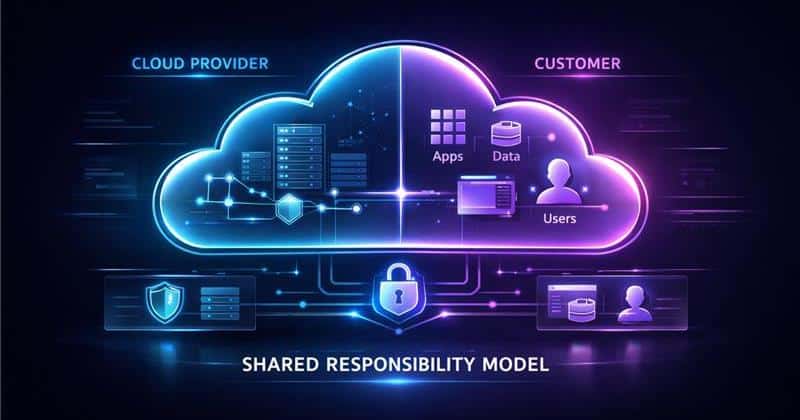
The shared responsibility model defines how security and compliance duties are divided between cloud providers and customers.
The provider is responsible for securing the cloud infrastructure.
The enterprise is responsible for securing its workloads, data, identities, and configurations.
Responsibility Across Service Models
Infrastructure as a Service IaaS
- Provider: Physical data centres, networking, hypervisors
- Customer: Operating systems, applications, access control, data protection
Platform as a Service PaaS
- Provider: Infrastructure and runtime
- Customer: Application code, data classification, identity management
Software as a Service SaaS
- Provider: Application stack and availability
- Customer: User access, data governance, compliance alignment
The model evolves by service layer, but enterprise accountability never disappears.
Four Critical Areas Where the Shared Responsibility Model Demands
Enterprise Action
1. Identity and Access Control
In the cloud, identity is the control plane.
Cloud providers secure infrastructure. They do not manage who inside your organization has access to what. That responsibility remains internal.
If privilege escalation, stale access rights, or weak authentication exist, the exposure is yours.
Enterprises must enforce structured identity governance across environments through role-based access control, least privilege principles, and strong authentication mechanisms. This is not an IT hygiene task. It is a business risk control.
When identity governance is mature, breach probability decreases and insider misuse risk drops significantly. When it is weak, attackers do not need to break in. They simply log in.
2. Data Protection and Compliance Accountability
Cloud infrastructure resilience does not equal data compliance.
Encryption, classification, retention, and residency requirements remain enterprise obligations under the shared responsibility model. Regulators assess how your organization governs data, not how your cloud vendor designs data centers.
Security leaders must ensure data is classified correctly, encrypted consistently, and aligned with regulatory frameworks relevant to the industry.
For regulated sectors such as financial services and healthcare, this alignment directly impacts audit outcomes and regulatory exposure.
At Welkin by Claritus, cloud security architecture is designed to integrate governance, compliance controls, and monitoring into a unified operating model rather than scattered technical configurations.
3. Configuration and Cloud Security Posture
Most cloud incidents stem from misconfiguration, not infrastructure failure.
Microsoft clearly states that customers are responsible for secure configuration of the services they deploy in Azure.
This includes storage permissions, access policies, logging configurations, and network controls.
In multi cloud environments, configuration drift is inevitable. Without continuous posture monitoring and automated compliance validation, small gaps can remain undetected until exploited.
Enterprises that operationalize configuration governance reduce exposure windows and improve incident detection speed.
4. Governance, Visibility, and Continuous Oversight
Policies alone do not operationalize the shared responsibility model.
Cloud Governance requires defined ownership, centralized visibility across environments, executive-level reporting, and financial oversight.
Security, compliance, and finance must operate with shared visibility into cloud risk and usage patterns.
When governance is embedded into operations, cloud spend becomes optimized, audit cycles accelerate, and leadership gains defensible oversight.
Through structured frameworks and managed services, Welkin by Claritus enables enterprises to sustain this governance maturity while scaling digital transformation initiatives.
Common Challenges in Operationalizing the Shared Responsibility Model
- Ambiguity in responsibility mapping
- Siloed security and IT functions
- Tool fragmentation across cloud environments
- Limited internal cloud security expertise
How to Address These Gaps
- Define responsibility matrices aligned to IaaS, PaaS, and SaaS
- Integrate cloud governance with enterprise risk frameworks
- Automate compliance validation and posture monitoring
- Implement managed oversight with continuous reporting
Welkin by Claritus bridges strategic planning with operational execution across cloud migration, governance, licensing, and managed services.
Measurable Business Benefits
When enterprises partner with Welkin by Claritus to operationalize cloud security and the shared responsibility model, they typically realize:
- Faster compliance audits
- Reduced misconfiguration incidents
- Improved executive-level risk visibility
- Lower long term remediation costs
- Stronger cyber resilience
Most importantly, accountability becomes clear and defensible at the board level.
Conclusion
The shared responsibility model is not simply a technical guideline. It is a leadership mandate.
As enterprises accelerate cloud adoption, accountability intensifies. CIOs, CISOs, and risk leaders must embed governance, identity controls, configuration management, and compliance automation into their cloud strategy.
If your enterprise is scaling cloud environments and needs clarity on accountability, risk, and compliance alignment, now is the time to act.
Explore Cloud Security & Governance with Welkin
Frequently Asked Questions (FAQs)
1. What is the shared responsibility model in cloud security
The shared responsibility model defines how security responsibilities are divided between a cloud provider and the customer. The provider secures the infrastructure of the cloud, while the enterprise secures data, identities, applications, and configurations deployed in the cloud.
2. How does the AWS shared responsibility model differ across IaaS, PaaS, and SaaS
In IaaS, customers manage operating systems and applications. In PaaS, customers manage applications and data while the provider manages runtime and infrastructure. In SaaS, customers primarily manage user access and data governance. The level of customer responsibility decreases as managed services increase.
3. Why is the shared responsibility model important for CIOs and CISOs
CIOs and CISOs remain accountable for compliance, data protection, and risk management even when using public cloud platforms. Understanding responsibility boundaries prevents audit failures, regulatory penalties, and security incidents.
4. How does Cloud Governance strengthen the shared responsibility model
Cloud Governance ensures policies, monitoring, and controls are enforced consistently across cloud environments. It transforms responsibility from theory into operational execution through automation, reporting, and continuous oversight.
5. How can Welkin by Claritus help enterprises implement cloud security and governance
Welkin by Claritus provides cloud migration strategy, cloud security and governance frameworks, licensing optimization, and managed services. This enables enterprises to operationalize the shared responsibility model with measurable compliance and security outcomes.
