







What Adobe’s Announced Semrush Acquisition Means for Enterprise Digital Strategy
Editorial note: This article is an independent educational analysis based on publicly available information about Adobe’s announced agreement to acquire Semrush. It does not provide investment, legal, or commercial advice, and it should not be read as an endorsement of either company or a prediction of regulatory or market outcomes.
A customer can now form an opinion about your company without ever visiting your website.
They might ask an AI assistant to compare vendors, find a software provider, recommend a product, or explain a business problem. By the time they reach your website, the shortlist may already have been created.
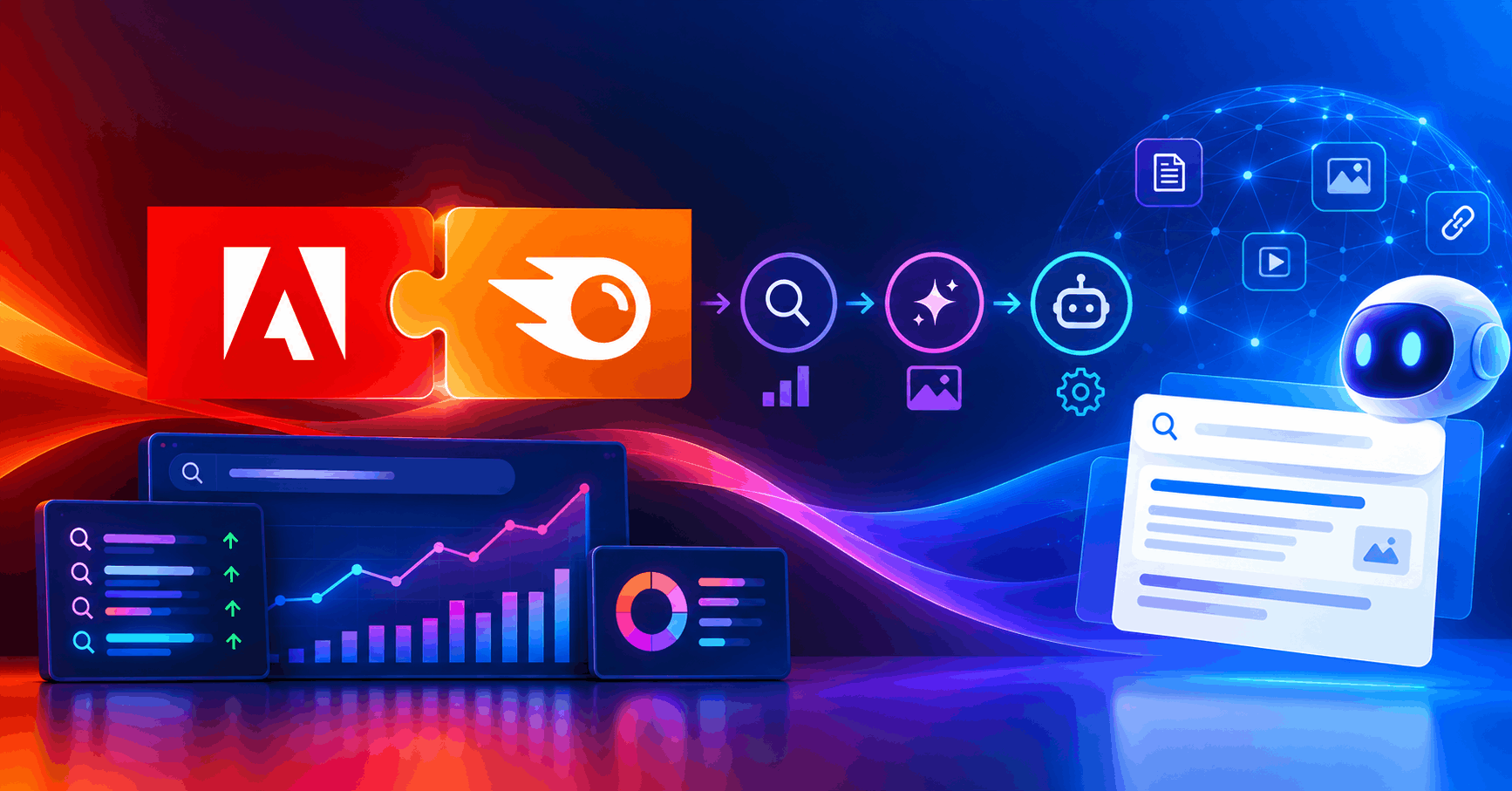
This article is not a product endorsement or partner announcement. It uses Adobe’s announced agreement to acquire Semrush as a constructive signal of how enterprise discoverability is evolving, especially as search, AI-generated answers, content systems, and customer experience platforms begin to overlap.
In simple terms, Adobe’s announced Semrush acquisition reflects the growing value of search data, AI visibility, and digital demand intelligence in enterprise strategy.
That is why Adobe’s announced agreement to acquire Semrush is useful to examine beyond the headline value. Adobe has described the approximately $1.9 billion agreement as a move connected to discoverability, conversion, and the growing role of AI interfaces and agents in customer journeys.
The obvious interpretation is that Adobe wants stronger SEO and AI-search capabilities.
The more important interpretation is this:
One useful way to read the move is that Adobe may be extending its focus from managing digital experiences to understanding the earlier moments when customers decide which brands deserve attention.
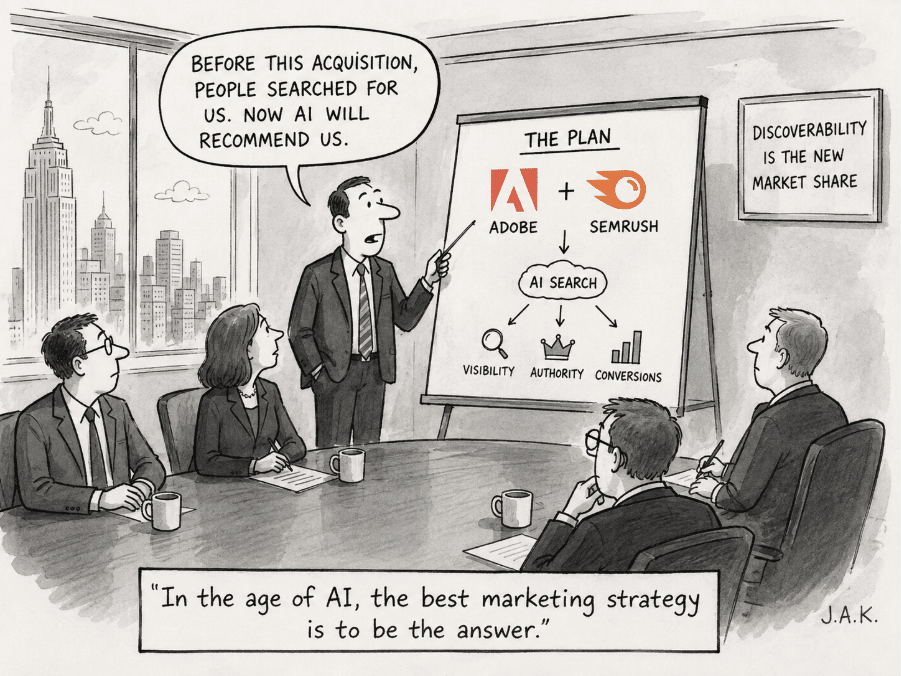
For businesses, that makes the acquisition useful to study even beyond the software industry.
Key Takeaways:
- Search is becoming a source of market intelligence, not only a traffic channel.
- AI search is expanding SEO into AEO, GEO, and broader discoverability work.
- Customer experience can begin before a visitor reaches the website.
- Data quality, content structure, and governance are becoming visibility factors.
- Enterprises may need digital foundations that stay reliable as discovery channels change.
For enterprise leaders, the important question is not whether one software acquisition changes SEO overnight. The question is what the deal reveals about the way visibility, customer intent, content operations, and AI-assisted discovery are beginning to converge.
What Did Adobe Actually Buy?
The easiest way to understand the announced acquisition is to stop thinking about Semrush only as an SEO dashboard.
Its more strategic asset is information about digital demand and visibility.
Adobe has said Semrush brings a proprietary SEO corpus containing 28.5 billion keywords and 43 trillion backlinks built over 17 years, alongside intelligence related to AI visibility, prompts, competitors, and brand mentions.
That is difficult data to recreate overnight.
It tells an enterprise more than where a page ranks. It can help reveal:
- What customers are searching for
- Which topics are gaining attention
- What competitors are visible for
- Which brands are being cited
- Where content authority exists
- Where visibility is being lost
- What customers are asking AI systems
That changes the value of search intelligence.
For years, the question was:
“How do we rank for this keyword?”
The bigger enterprise question is becoming:
“What is the market asking, where is attention moving, and are we present when that demand appears?”
That is a market intelligence problem, not merely an SEO problem.
What This Acquisition Shows About Discoverability
This is where the announced acquisition becomes useful as a way to understand the changing role of discoverability in digital strategy.
Adobe technologies are often associated with content creation, digital experience management, customer behaviour analysis, and commerce. Search intelligence adds another layer to that journey.
Semrush represents a type of intelligence that sits before many brand-controlled experiences:
Discoverability.
Consider the traditional flow:
Create → Publish → Attract → Engage → Convert
Now place AI-driven discovery in front of it:
Customer intent → Discoverability → Content → Experience → Conversion
That first stage is becoming harder to control.
A customer may not begin with your homepage. They may begin with an AI-generated answer that determines which companies are worth investigating.
This is also visible in how Adobe describes Brand Visibility, which connects Semrush search intelligence with AI visibility, content optimization, and Adobe Experience Manager so brands can better understand their presence across search and AI surfaces.
From an educational perspective, the point is not simply better rankings.
It is the growing importance of understanding how customers discover, compare, and shortlist brands before entering the traditional digital funnel.
Seen this way, the announced acquisition points to four enterprise shifts: search data is becoming market intelligence, SEO is expanding into broader discoverability, customer experience is starting before the website visit, and data architecture is becoming part of visibility strategy.
Rather than treating the deal as a single-company story, enterprises can use it as a lens for a broader industry movement: visibility is becoming a shared concern across marketing, data, technology, and customer experience teams. The following four shifts explain why.
The First Enterprise Shift: Search Becomes Market Intelligence
This shift is easiest to understand when search data is viewed as one form of market signal, not only as a traffic source.
Suppose an industrial technology company notices a sudden rise in searches and AI questions around predictive maintenance.
An SEO team may initially see an opportunity to create content around the topic.
But the same signal could matter to:
- Product teams, deciding what capabilities customers want.
- Sales teams, refining messaging.
- Marketing teams, adjusting demand-generation campaigns.
- Customer experience teams, changing how solutions are presented.
- Strategy teams, identifying where the market is moving.
The search signal is the same. The decision attached to it is different.
That is the important shift.
Search data can act as an early indicator of changing customer demand.
This does not mean every keyword trend should influence product strategy. Search data is only one signal among many.
But enterprises that treat search purely as a traffic channel may be leaving useful market intelligence on the table.
The announced Semrush acquisition is a useful example of how that kind of signal is becoming part of the broader enterprise technology conversation.
The Second Enterprise Shift: “SEO” Is Becoming a Broader Discoverability Problem
The industry now has several terms for this new environment.
- SEO focuses on traditional search visibility.
- AEO focuses on answer-driven discovery.
- GEO focuses on visibility within generative AI responses.
- Agentic search optimization focuses on helping AI agents discover information and complete actions.
It is tempting to treat each as another specialized marketing discipline.
That would miss the bigger picture.
The underlying problem is the same:
Can your business be found, understood, trusted, and considered when a customer asks for an answer?
That requires much more than adding keywords to webpages.
It depends on whether an enterprise has:
- Clear and authoritative content
- Consistent product and service information
- Strong information architecture
- Structured data
- Reliable knowledge sources
- Technical accessibility
- Up-to-date digital properties
In that sense, AI search is exposing the quality of an enterprise’s information infrastructure.
A company with fragmented, contradictory or outdated information may have a marketing problem today.
In an AI-driven environment, it may have a much larger operational problem.
The Third Enterprise Shift: Your Digital Experience Starts Earlier
For a long time, customer experience programs focused on what happened after someone arrived.
A company optimized its homepage, redesigned its checkout, personalized its content, improved navigation, and introduced analytics.
AI introduces a different starting point.
Imagine a procurement team evaluating data platforms for a global manufacturer that operates across multiple regulatory environments.
An AI system may synthesize information from dozens of sources and produce a shortlist.
The customer has already entered a decision process. The shortlisted vendors have already gained an advantage. Everyone else is trying to get into consideration after the fact.
This changes the role of customer experience.
The website remains important, but it is no longer the only environment in which the experience begins. AI can influence who gets considered before a brand-controlled experience even starts.
The Fourth Enterprise Shift: The Data Architecture Starts Showing Its Cracks
This is perhaps the least obvious consequence of the announced acquisition.
AI-driven discovery puts pressure on the information underneath the customer experience.
Consider a large enterprise where:
- Product specifications live in one system
- Pricing lives somewhere else
- Marketing content sits in a CMS
- Customer information sits in a CRM
- Analytics data sits in another platform
- Internal documentation is spread across SharePoint, PDFs, and legacy applications
A human employee can often reconcile these inconsistencies.
An AI system may surface them instead.
If different sources describe the same product differently, the enterprise has a data consistency problem.
If important information is inaccessible to the systems expected to use it, there is an integration problem.
If nobody owns the accuracy of information being surfaced externally, there is a governance problem.
AI search therefore creates an unusual pressure:
AI search may therefore create a useful opportunity: it can encourage enterprises to turn internal information debt into stronger, more reliable customer experiences.
That makes data integration, application modernization, APIs, knowledge management, analytics and governance more strategically relevant.
This is where the Adobe-Semrush story intersects with broader digital transformation.
The Financial Question: What Happens to the Value of Visibility?
The financial question is how enterprises should value visibility when the user no longer needs to click through a page of search results.
The traditional funnel has relatively familiar measurements:
Ranking → Click → Visit → Lead → Conversion
AI-mediated journeys can compress that path. A customer might receive a recommendation, evaluate several brands inside an AI interface, and then visit only the final few providers.
That creates an attribution problem. A company could see fewer traditional organic clicks while still benefiting from being repeatedly mentioned in AI-generated answers.
Conversely, a company could retain strong website traffic while gradually losing the consideration stage to competitors that appear more frequently in AI recommendations.
That means enterprises may need to look beyond traffic as the sole measure of digital visibility.
Emerging metrics could include:
- AI mentions
- AI citations
- Share of AI visibility
- Brand presence across relevant prompts
- Qualified AI-referred traffic
- AI-assisted conversions
These should not yet be treated as universal standards. The measurement ecosystem is still developing.
The strategic point is more fundamental:
The business value of being visible may increasingly exist before a click occurs.
How Enterprises Can Stay Practical as AI Search Evolves
A practical view is important because AI search is still evolving.
- AI search is changing quickly.
- Measurement is immature.
- Traditional search still matters.
The better response is:
“Build a digital foundation that can remain discoverable as interfaces change.”
That means keeping technical SEO strong while improving content structure, data quality, customer experience, analytics, and AI readiness.
In other words, enterprises should not optimize for one chatbot.
They should optimize for adaptability.
The interfaces will change. The competitive advantage will belong to enterprises whose content, data, systems, and governance can adapt with them.
Continue the Conversation
As AI search, SEO, AEO, GEO, and customer experience continue to evolve, enterprises have an opportunity to review how their content, data, systems, and governance support discoverability.
For organizations exploring these questions, Claritus can help assess the digital foundations needed for a more AI-ready customer journey.
Frequently Asked Questions on Staff Augmentation (FAQs)
1. What does Adobe’s announced Semrush acquisition mean for SEO?
Adobe’s announced agreement to acquire Semrush suggests that SEO is becoming part of a broader discoverability strategy that includes AI search, answer engines, generative AI visibility, content quality, data consistency, and customer experience.
2. Does AI search replace Google?
No. AI search is emerging alongside traditional search rather than eliminating it. Many users will continue using search engines while turning to AI assistants for research, comparisons, recommendations, and more conversational queries.
3. Do companies need a dedicated GEO team?
Not necessarily. GEO can initially be handled across existing SEO, content, digital marketing, and technical teams. Dedicated ownership becomes more useful as AI visibility becomes a significant acquisition or brand-management channel.
4. How can businesses measure AI search performance?
Companies can track AI mentions, citations, referral traffic, branded queries, visibility across relevant prompts, engagement, and conversions. Measurement is still evolving, so these metrics should complement rather than replace established marketing KPIs.
5. What capabilities may enterprises need as AI-driven discovery evolves?
Enterprises may need stronger capabilities across AI readiness, data quality, analytics, SEO, cloud platforms, application development, content operations, and governance. Some organizations may build these skills internally, while others may use external support for specific initiatives or longer-term team development.
6. Is AI search relevant for B2B companies?
Yes. B2B buyers often research vendors extensively before contacting sales teams. AI-generated comparisons and recommendations can influence which companies enter that consideration set, making discoverability increasingly relevant to B2B demand generation.
