







Cloud Migration in 2026
A Practical Roadmap for CIOs
Cloud Migration in 2026 is a strategic infrastructure decision with long-term operational consequences. It influences capital allocation, regulatory posture, cybersecurity architecture, application performance, and the organisation’s ability to operationalise AI at scale.
For many enterprises, the complexity lies less in moving workloads and more in structuring the cloud environment correctly. Hybrid estates, legacy systems, fragmented data platforms, and evolving compliance mandates create architectural friction. Without a defined Cloud Migration Strategy, migration efforts can introduce cost variability, governance gaps, and technical debt that compounds over time.
Welkin by Claritus, the dedicated cloud practice of Claritus Consulting, delivers Cloud migration services that align architecture, governance, and cost control from the outset. The roadmap below outlines how CIOs can execute Cloud Migration in 2026 with precision and operational integrity.
Why Cloud Migration Is Urgent in 2026
The data is clear.
According to Microsoft and IDC research, organisations are seeing 3.7x ROI for every $1 invested in generative AI.
Yet:
Cyber risk is also escalating. IBM reports the average cost of a data breach reached $4.88 million globally.
What Azure Migration Means in 2026
Modern Azure migration is not just moving workloads to virtual machines.
It spans a migration spectrum:
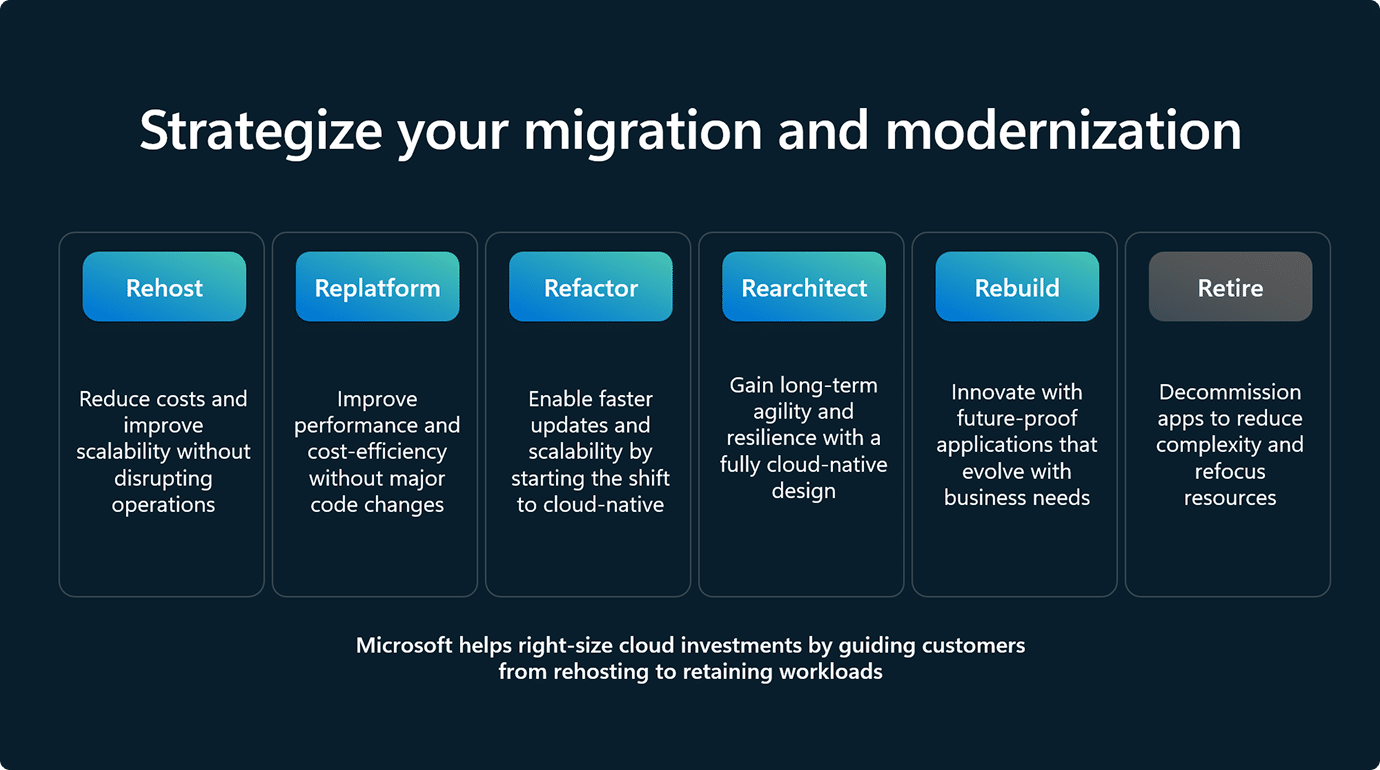
The wrong choice creates cost overruns and operational risk.
The right choice accelerates agility and innovation.
At Welkin by Claritus, migration is treated as a continuum:
Extend cloud → Migrate and modernise → Rearchitect → Rebuild
Each organisation sits at a different maturity level. The roadmap must reflect that.
Explore our structured approach here.
Why Azure as the Strategic Cloud Foundation
Azure is positioned as a cloud designed for enterprise-grade workloads.
Microsoft reports that organisations migrating to Azure experience:
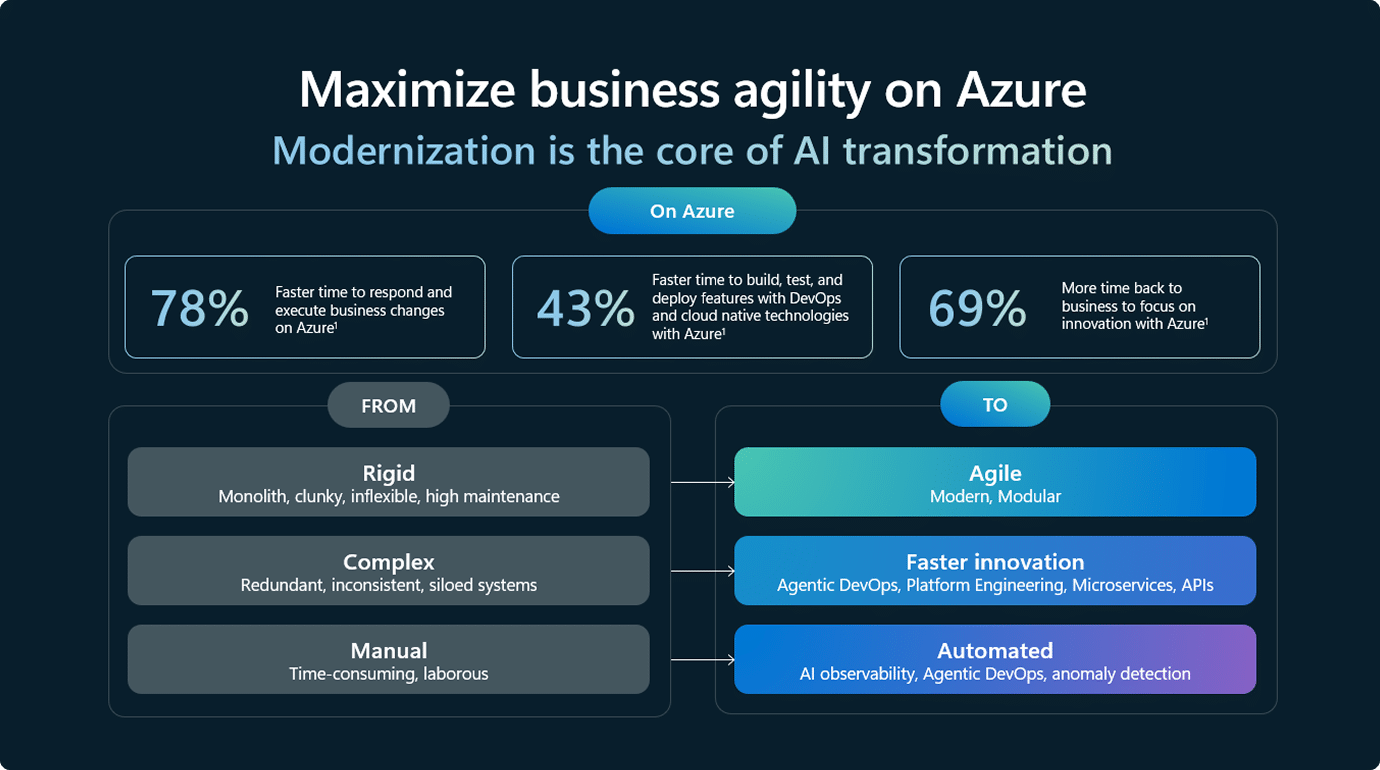
Azure also offers:
- Unified data platforms for AI
- Integrated security posture management
- Broad compliance certifications
- Hybrid and multicloud flexibility
Microsoft states that Azure analyses 84 trillion threat signals daily, reinforcing its security posture.
Azure also supports:
- Windows Server VMs
- Linux VMs
- Azure VMware Solution
- Azure SQL
- PostgreSQL
- AKS
- App Service
- Microsoft Defender for Cloud
This breadth ensures both legacy and modern workloads are supported.
The 5-Step Azure Migration Roadmap for 2026
1. Envision the Future State
Before touching infrastructure, define direction.
An Envisioning Session aligns business priorities with technology reality.
This is where you clarify:
- What must improve immediately
- What must modernise for AI
- What risks cannot continue
Cloud transformation begins with strategic clarity, not workload movement.
Outcome:
A board-aligned migration vision and defined success metrics.
2. Assess and Rationalise the Estate
Now you evaluate your IT estate with discipline.
Every workload is categorised across the migration spectrum:
Rehost. Replatform. Refactor. Rearchitect. Rebuild. Retire.
- Some systems should move quickly.
- Some should modernise.
- Some should be eliminated.
This step prevents blind lift-and-shift decisions.
Outcome:
A rationalised migration matrix with financial and risk visibility.
3. Build the Azure Landing Zone
Migration without governance creates future instability.
The Azure Landing Zone establishes:
- Security baselines.
- Identity and access control.
- Network architecture.
- Policy enforcement.
- Cost governance guardrails.
This is also where Microsoft Defender for Cloud is integrated to secure from code to cloud.
The landing zone is your enterprise control tower.
Outcome:
A secure, compliant, audit-ready cloud foundation.
4. Migrate and Modernize with Intent
Execution begins, but not blindly. Workloads follow their defined path:
- Rehost for speed.
- Replatform for optimisation.
- Refactor or Rearchitect for long-term innovation.
Modernisation goes beyond moving workloads. It brings together unified data platforms that eliminate silos, cloud-native services that improve scalability and resilience, and AI readiness enablement that prepares the organisation for advanced analytics and intelligent automation. This is the stage where infrastructure evolves from static and reactive to intelligent, adaptive, and innovation driven.
Outcome:
Improved agility, reduced technical debt, and AI-capable architecture.
5. Govern, Optimise and Scale
Cloud transformation does not end at migration.
It continues through disciplined cost optimisation, continuous security posture management, structured operational governance, proactive performance monitoring, and AI-driven automation. At this stage, FinOps principles are embedded into daily operations, ensuring sustained cost efficiency and financial transparency. Cloud stops being a migration milestone and becomes an enduring operating model that drives control, resilience, and long-term value.
Outcome:
Predictable spend, proactive security, and scalable innovation.
The Practical Roadmap for CIOs
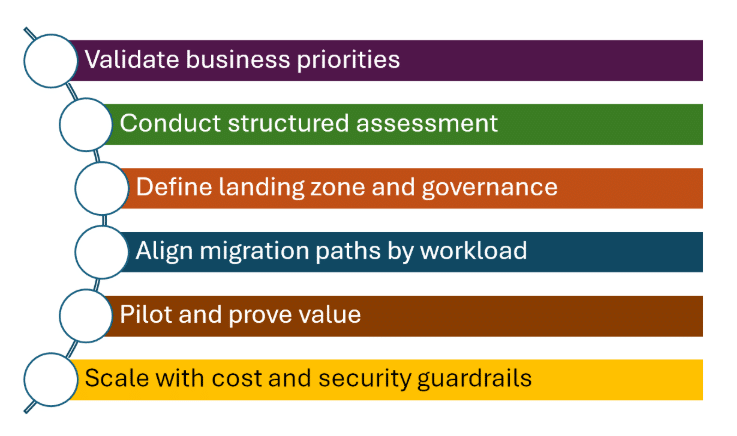
Cloud transformation is a continuum. Not a single event.
Why Welkin by Claritus
Welkin by Claritus brings:
- Structured Cloud migration services
- Proven Cloud Migration Strategy frameworks
- Azure security and governance expertise
- Licensing and cost optimisation advisory
- End-to-end managed services
We do not just move workloads.
We build sustainable cloud operating models.
Cloud Migration in 2026 requires more than ambition. It requires clarity, governance, and execution discipline.
If you are planning your next phase of Azure migration, now is the time to design it strategically.
Explore Solutions with Welkin by Claritus
FAQs: Azure Migration in 2026
1. What is the right Cloud Migration Strategy for enterprises in 2026?
A strong Cloud Migration Strategy in 2026 starts with an envisioning session, followed by workload assessment across rehost, replatform, and refactor options. It must include a secure Azure Landing Zone, embedded governance, cost optimisation, and AI readiness from the beginning.
2. How do CIOs choose between rehost and refactor in Azure migration?
Rehost works for speed and stable applications. Refactor or rearchitect is better for performance optimisation, scalability, and AI enablement. The decision should balance urgency, technical debt, cost efficiency, and long-term innovation goals.
3. Why is an Azure Landing Zone important?
An Azure Landing Zone establishes identity controls, network architecture, security baselines, compliance guardrails, and cost governance before workloads are migrated. It ensures audit readiness and prevents uncontrolled cloud sprawl.
4. How does Azure migration improve AI readiness?
Azure migration enables unified data platforms, scalable infrastructure, and cloud-native services. By eliminating data silos and modernising workloads, enterprises create a secure and AI-ready foundation for advanced analytics and automation.
5. How can enterprises control cloud costs after migration?
Cost control requires embedded FinOps practices such as right-sizing, reserved capacity planning, continuous monitoring, and policy-based governance. Cloud must be managed as an ongoing operating model, not a one-time project.
