








How Hybrid Talent Models Are Redefining IT Delivery in 2026

The uncomfortable truth about IT delivery in 2026
If you’re relying on IT staff augmentation services to keep delivery moving, you’re not alone—but the problems teams face today aren’t always solved by adding more hands.
A critical deployment was scheduled for Friday. By Wednesday, the cracks had already started to show.
Not because the system design was flawed. The architecture had been reviewed. The pipelines were in place. But a key backend dependency wasn’t fully owned. One engineer was stretched across two modules. A late-stage compliance flag came in with no clear escalation path.
By Thursday night, leadership was asking the same question every delivery team dreads: “What exactly is blocking us?”
No one had a clean answer. Because nothing had “failed” in isolation. The system was working. The people were capable. The plan made sense.
What broke was the structure of delivery itself. This is where most organizations find themselves today. Not in crisis, but in a constant state of friction. Teams are overloaded, hiring can’t keep up with evolving tech stacks, and delivery accountability is spread too thin across internal teams and external vendors.
This is exactly where IT staff augmentation services (also called staff augmentation or resource augmentation) have traditionally stepped in: fill the gaps, add bandwidth, and keep delivery moving.
But in 2026, that approach on its own is starting to show its limits.
Because the real challenge isn’t just access to talent. It’s how that talent is structured, governed, and aligned to outcomes. What’s emerging instead is a more deliberate approach. Organizations are combining IT staff augmentation services, managed services, and internal teams into a single, coordinated delivery model.
A hybrid talent model. And it’s not just improving delivery. It’s redefining how modern IT teams operate under pressure.
Why this shift is happening now
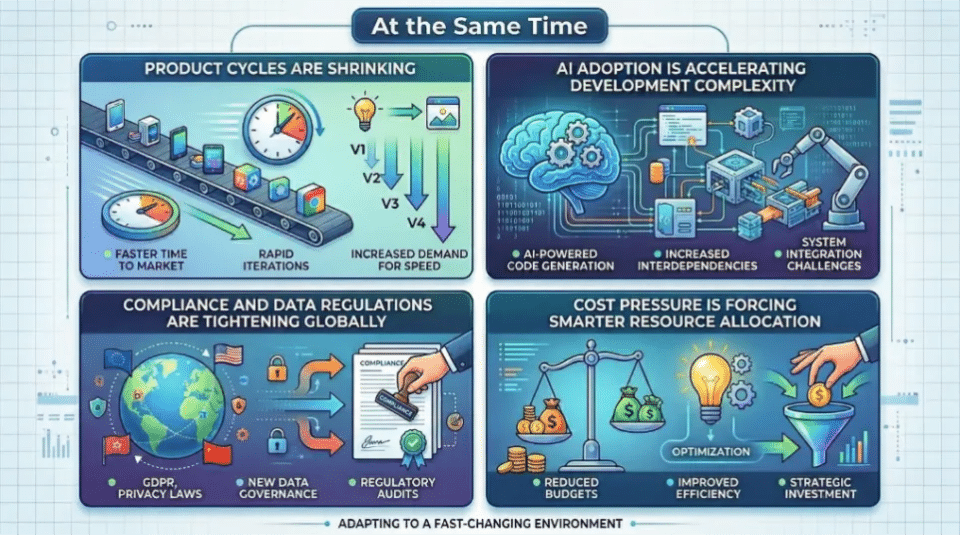
The market didn’t randomly evolve into hybrid models. It was forced to—because modern delivery breakdowns are rarely about competence; they’re about ownership, coordination, and governance across fast-moving teams.
According to McKinsey & Company, nearly 87% of organizations report skill gaps or expect them soon, making traditional hiring models insufficient.
What a hybrid talent model looks like in practice (for IT delivery)
A hybrid talent model is a structured combination of internal teams, staff augmentation, and managed services, aligned under a unified delivery and governance framework.
Instead of choosing between models, you:
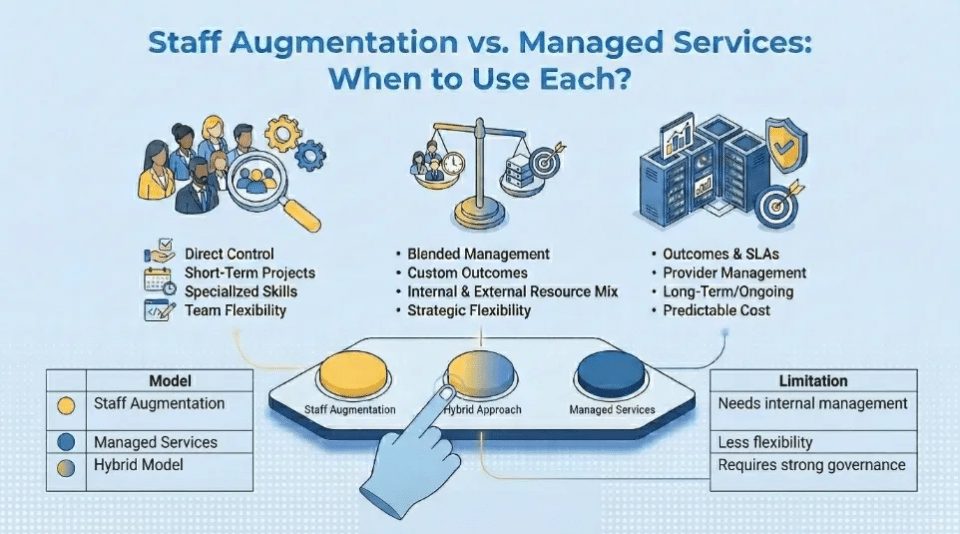
Key point: A hybrid talent model isn’t a compromise between staffing and outsourcing—it’s an optimization strategy that intentionally assigns the right work to the right delivery layer (internal teams, augmentation, and managed services). That’s also why delivery models themselves have become a competitive advantage: they determine how fast you can execute, how well you control risk, and how predictably you can ship.
Delivery risk today is multidimensional. It’s not just about deadlines—it’s also about:
- Skill availability
- Cost volatility
- Compliance exposure
- Operational continuity
Hybrid models directly address:
- Talent shortages without long hiring cycles
- Over-reliance on vendors or internal teams
- Budget overruns due to inefficient resourcing
- Fragmented accountability across delivery units
5 Real Shifts Hybrid Talent Models Are Driving in IT Delivery
These shifts show up when hybrid models are implemented with intent, not as a staffing patch, but as a delivery design choice. Here’s what leading IT organizations are changing first.
1. On-demand scalability without long-term cost burden
Traditional hiring locks organizations into fixed capacity, regardless of actual demand. While staff augmentation introduces flexibility, it often lacks continuity across delivery cycles.
Hybrid models solve this by aligning talent with workload in real time. Teams expand during peak phases, contract when demand stabilizes, and bring in specialized expertise only when required. This creates a system where capacity is no longer a constraint but a lever.
Result: A significantly improved cost-to-output ratio without compromising delivery momentum.
2. Risk is distributed, not concentrated
One of the most underestimated risks in IT delivery is single-point dependency, whether on an individual, a team, or a vendor.
Hybrid models reduce this exposure by distributing responsibility across layers. Internal teams retain strategic control, augmented resources drive execution flexibility, and managed services take ownership of critical or repeatable functions.
This layered structure builds resilience into delivery itself, ensuring that no single disruption derails the entire system.
Outcome: Greater continuity, lower failure impact, and stronger delivery confidence.
3. Speed comes from parallel execution, not pressure
Most delays in IT delivery are not caused by complexity but by sequential workflows. Work moves step by step, creating bottlenecks that compound over time.
Hybrid models unlock parallel execution. Core teams focus on architecture and decision-making, augmented teams accelerate development, and managed service providers handle testing, deployment, or support simultaneously.
In practice, organizations using blended delivery models often see faster release cycles because work can move in parallel across architecture, development, testing, and deployment.
Impact: Faster time-to-market without overloading internal teams.
4. Governance shifts from reactive to intentional
As delivery models become more complex, governance can no longer be informal or reactive. Hybrid setups demand clarity by design.
Effective hybrid governance defines ownership boundaries upfront, aligns teams through measurable SLAs and KPIs, and ensures visibility through centralized reporting and integrated communication systems.
Where most organizations struggle is not execution but orchestration. Without structured governance, even the best talent models fail to deliver consistently.
Shift: From firefighting issues to proactively managing delivery systems.
5. Capability expands without waiting for hiring cycles
Technology evolves faster than organizations can hire for it. Relying solely on internal hiring creates inevitable capability gaps.
Hybrid models allow immediate access to specialized skills, whether for emerging technologies, short-term needs, or high-complexity projects. This reduces dependency on long upskilling cycles and enables continuous capability expansion.
Insights from Adobe highlight that organizations investing in flexible talent strategies are far more likely to achieve innovation-driven growth.
Advantage: Access to the right expertise at the right time, without slowing down delivery.
Taken together, these five shifts make delivery faster and more resilient, but only when the model is designed with clear ownership and operating rhythms. That’s where many organizations get stuck.
Challenges in hybrid models and how to solve them
Hybrid models are not plug-and-play. It comes with challenges:
The fix isn’t to add more people—it’s to tighten the operating model so every layer knows how workflows, who owns decisions, and how issues escalate.
1. Misaligned accountability
Solution: Define ownership clearly across all layers
Once ownership is clear, the next failure point is usually coordination: teams may be aligned on goals but misaligned on day-to-day information flow.
2. Communication gaps
Solution: Use unified collaboration tools and reporting
Even with strong communication, hybrid models can drift into over-reliance—especially when a single partner becomes the default owner of critical delivery paths.
3. Vendor dependency risks
Solution: Diversify and integrate vendor roles
Finally, as you add delivery layers, lightweight coordination stops being enough. You need governance that scales with complexity without slowing teams down.
4. Governance complexity
Solution: Build a centralized delivery governance model
Conclusion
The goal isn’t to adopt a new model for its own sake. It’s to build a delivery system that can scale, adapt, and stay accountable as priorities shift.
Hybrid talent models are not just improving IT delivery. They are redefining it.
Organizations that are blending staff augmentation, resource augmentation, and managed services are seeing faster ramp-ups, better continuity, and more predictable outcomes.
What this looks like in the real world is a delivery model that ramps up quickly, stays stable through change, and keeps accountability clear, without forcing your internal teams into constant firefighting. That’s the kind of outcome Claritus is brought into support.
- Helped a leading telecom enterprise accelerate hiring cycles and reduce time-to-fill, so critical initiatives could move from planning to execution faster.
- Supported one of India’s top tech companies to scale engineering teams rapidly without disrupting delivery continuity during high-demand phases.
In both cases, the value wasn’t “more people.” It was a better way to combine talent, ownership, and operating cadence, turning staff augmentation into a hybrid delivery system that scales with less risk.
If you want to explore this further:
- Read more on staff augmentation vs hiring
- Understand how workforce agility is redefining IT staff augmentation services
Want a hybrid delivery model that actually works?
Start with a quick assessment with Claritus Consulting.
Book a Workforce Strategy Assessment
Claritus Consulting can help you translate strategy into execution—by defining the right mix of IT staff augmentation services, managed services, and internal ownership, along with the governance to keep delivery predictable. Start with a short assessment to identify where you’re losing time or accountability and what to change first.
Frequently Asked Questions (FAQs)
1. What is staff augmentation and how is it different from managed services?
Staff augmentation is a model where external talent is added to your existing team to fill skill gaps, while managed services involve outsourcing complete functions with defined outcomes and SLAs.
2. When should companies use IT staff augmentation services?
Companies should use IT staff augmentation services when they need quick access to specialized skills, want to scale teams rapidly, or are working on short-term or evolving projects.
3. How can Claritus Consulting help with a hybrid talent model?
Claritus Consulting helps organizations design and run hybrid delivery models by combining IT staff augmentation services with managed services under clear governance. We support you with role and responsibility mapping, rapid access to specialized talent, delivery oversight (SLAs/KPIs and reporting), and scalable teams that integrate with your internal engineering and product stakeholders—so you can improve speed, continuity, and accountability without losing control.
4. How do hybrid talent models work in IT delivery, and how do they reduce risk?
A hybrid talent model combines internal teams, staff augmentation, and managed services into a single delivery structure with clear ownership. This improves flexibility and speed while reducing risk by distributing responsibility across delivery layers, minimizing single-point dependency, and enabling stronger governance and continuity.
5. Are hybrid workforce models cost-effective compared to traditional hiring?
Yes, hybrid models optimize costs by aligning talent with demand, reducing bench costs, and avoiding long-term hiring overheads while maintaining delivery efficiency.
