







When AI Writes the Code, What Exactly Are Companies Hiring Developers For?
Quick Answer
As AI takes on more coding tasks, enterprises are shifting their focus from code production to problem-solving, architecture, business understanding, validation, and delivery outcomes. The value of developers is increasingly defined by judgment, not just execution.
Key Takeaway
AI is changing what developers do, but it is not eliminating the need for developers. Organizations are increasingly hiring for capability, ownership, and engineering judgment rather than coding speed alone.
Introduction
An engineering manager opens a new hiring request.
A few years ago, the requirement might have been straightforward:
- Java Developer
- Front-End Developer
- QA Engineer
Today, the discussion often sounds different.
The team already has access to AI-powered development tools. Code can be generated faster. Unit tests can be created automatically. Documentation can be drafted in minutes. Routine development tasks that once consumed hours now take significantly less time.
Yet the hiring request still exists.
In many cases, it is becoming even more important.
What has changed is not the need for talent. What has changed is the definition of value.
The question organizations are increasingly asking is no longer:
“Who can write code?”
The question is:
“Who can help us solve the right problems, make the right decisions, and deliver the right outcomes?”
That distinction is becoming increasingly important for organizations investing in IT staff augmentation and engineering workforce solutions.
Has AI Reduced the Need for Developers?
The short answer is no.
What AI has done is reduce the amount of time developers spend on certain types of work.
Many coding activities that were previously manual are becoming assisted activities.
Developers can now generate boilerplate code more quickly.
They can identify errors faster.
They can create documentation more efficiently.
They can accelerate repetitive development tasks.
However, software delivery was never limited by typing speed.
Enterprise technology projects rarely fail because developers cannot write code quickly enough.
More often, challenges emerge because teams misunderstand requirements, design the wrong solution, struggle with integration complexity, or fail to align technology decisions with business needs.
AI helps with execution.
Organizations still need people to provide judgment.
If AI Can Generate Code, Where Does Human Value Shift?
The answer lies in the areas where context matters most.
AI can suggest a solution.
It cannot fully understand the commercial priorities, operational realities, or organizational constraints surrounding a business decision.
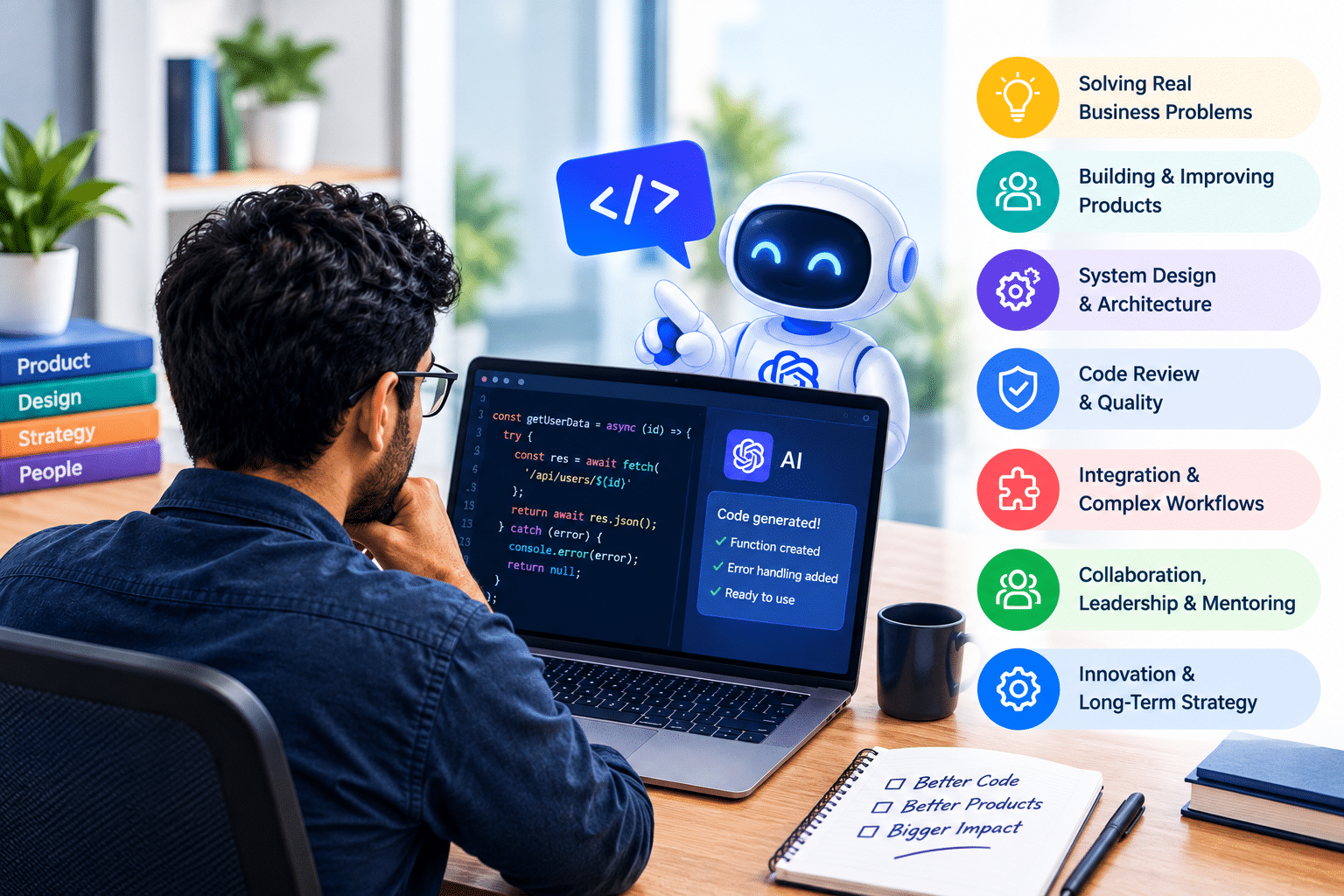
As a result, many organizations are placing greater emphasis on capabilities such as:
- Solution design
- Systems thinking
- Business analysis
- Architecture
- Stakeholder communication
- Risk assessment
- Quality validation
In other words, the value of engineering talent is moving closer to decision-making and problem-solving.
The organizations gaining the most from AI developer productivity are often those that combine automation with experienced engineering judgment.
Why Are Hiring Expectations Changing?
Consider a developer joining a project today.
Ten years ago, technical knowledge alone could often differentiate candidates.
Today, access to AI tools is becoming increasingly common across teams.
As technology access becomes more equal, organizations are paying closer attention to how individuals contribute beyond code creation.
Hiring managers increasingly look for people who can:
- Understand business objectives
- Translate requirements into solutions
- Evaluate AI-generated outputs
- Collaborate across technical and non-technical teams
- Identify risks before they become delivery issues
The expectation is changing from:
“Can this person write software?”
To:
“Can this person help us deliver successful outcomes?”
That shift is influencing how organizations assess both internal talent and external workforce partners.
What Does This Mean for IT Staff Augmentation?
The impact on staff augmentation services is significant.
Historically, staffing conversations often focused on technical skills, years of experience, and availability.
Those factors still matter.
However, organizations increasingly evaluate talent through a broader lens.
When augmenting engineering teams, leaders often want professionals who can:
- Adapt quickly to business environments
- Work effectively with AI-assisted workflows
- Contribute to architecture discussions
- Support delivery ownership
- Collaborate across distributed teams
The conversation moves beyond resource quantity.
It becomes a discussion about capability.
Organizations are not simply asking:
“How many developers do we need?”
They are asking:
What expertise will help us deliver the outcomes we’re aiming for?
That distinction is becoming increasingly important as AI changes engineering workflows.
Is Developer Productivity Being Redefined?
For years, productivity was often associated with visible outputs.
Examples included:
- Lines of code
- Tasks completed
- Development hours
- Tickets closed
AI is challenging those traditional measures.
If AI helps generate code faster, does more code necessarily indicate greater productivity?
Not always.
Many organizations now view productivity differently.
They focus on outcomes such as:
- Delivery quality
- Time to value
- System reliability
- Business impact
- Customer outcomes
This creates an interesting shift.
The highest-performing developers may not always be the people producing the most code.
They may be the individuals making the best decisions.
What Will Engineering Teams Look Like in the Next Few Years?
While every organization will evolve differently, several trends are becoming increasingly visible.
Future engineering teams are expected to place greater value on capabilities that improve decision-making, adaptability, and delivery outcomes.
Engineering Judgment
The ability to evaluate options, challenge assumptions, and make informed decisions.
Domain Expertise
Understanding how technology supports specific business environments.
Cross-Functional Collaboration
Working effectively with security, operations, product, and business teams.
AI Supervision
Reviewing, validating, and improving AI-generated outputs.
Outcome Ownership
Taking responsibility for results rather than simply completing assigned tasks.
These capabilities are difficult to automate because they rely heavily on context, experience, communication, and accountability.
The Talent Question Enterprises Are Really Asking
Claritus PerspectiveAI is reshaping software delivery, but it is also reshaping workforce strategy.
Organizations need engineering talent that can work effectively alongside AI while maintaining quality, accountability, and business alignment.
Claritus helps enterprises build scalable engineering teams through staff augmentation services designed around evolving delivery models, technical expertise, and long-term business objectives.
Build AI-Ready Engineering Teams
Frequently Asked Questions About IT Staff Augmentation and AI
What is AI-assisted software development?
AI-assisted software development involves using AI tools to support coding, testing, documentation, debugging, and other development activities. The goal is to improve efficiency while allowing engineers to focus on higher-value work.
Will AI replace software developers?
AI can automate certain development tasks, but organizations still need developers to design solutions, evaluate trade-offs, understand business requirements, and ensure delivery quality.
How is AI changing IT staff augmentation?
AI is shifting demand toward professionals who combine technical knowledge with problem-solving, collaboration, architecture, and delivery expertise. Organizations increasingly look beyond coding skills alone.
What skills are becoming more important for developers?
Many enterprises are placing greater emphasis on systems thinking, business understanding, communication, solution design, AI validation, and outcome ownership.
Why do companies still need developers if AI can generate code?
Software delivery involves much more than writing code. Successful outcomes depend on understanding requirements, making design decisions, managing risks, and ensuring that technology aligns with business objectives.
