








Résumé Inflation and AI Hiring: How Employers Can Verify Real Skills

Quick Answer:
Résumé inflation is increasing as candidates use AI tools to enhance applications, making it harder for employers to assess genuine capabilities. Skills-based hiring, structured assessments, and stronger verification processes help organisations identify candidates who can perform effectively in the role.
Key Takeaway:
In an AI-assisted hiring environment, organisations achieve better hiring outcomes by focusing on verified skills and demonstrated capabilities rather than relying solely on self-reported qualifications and experience.
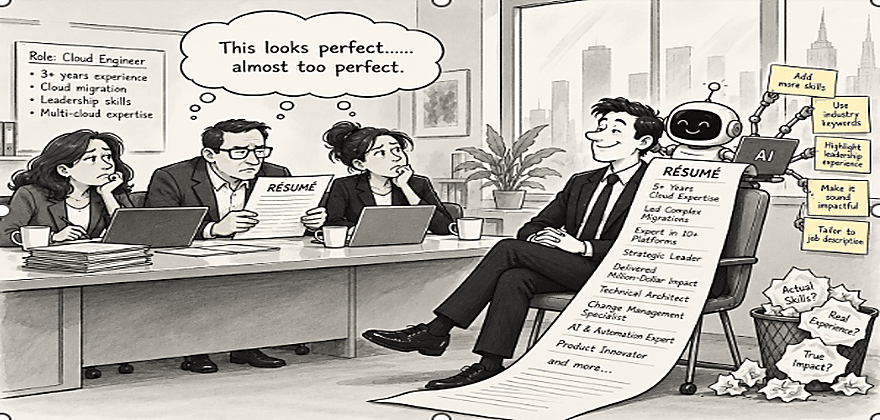
On paper, the role looks easy to fill. The job description asks for three years of experience, hands-on expertise in cloud platforms and the ability to lead complex migrations. Within days, HR has hundreds of applications, several résumés appear tailor-made for the position, the keywords match and the achievements sound impressive. The shortlist practically builds itself until the interviews begin.
One candidate cannot explain a project they claim to have led. Another lists tools they have barely used. A third describes impressive results but struggles to explain their own contribution. As the hiring team revisits the shortlist and its screening decisions, one question becomes impossible to ignore: how many applications reflect real capability, and how many simply know how to look qualified?
This is the résumé inflation problem: the résumé is becoming a less reliable signal of capability. AI tools can help candidates tailor applications, polish their language and present genuine experience more clearly. The same technology can also make unsupported accomplishments or unverified skills appear convincing, increasing the disconnect between what is presented on a résumé and what can be demonstrated in practice.
For HR teams already managing high application volumes, tight hiring deadlines and pressure from business leaders to fill critical roles, the consequences go beyond a few disappointing interviews. Screening takes longer, technical teams lose time, and vacancies remain open despite a seemingly strong pipeline.
AI assistance is not itself evidence of dishonesty. The relevant distinction is whether a tool helps a candidate express genuine experience or creates a misleading impression about skills, responsibility or results. An evidence-led hiring process supported at scale through Recruitment Process Outsourcing (RPO) evaluates key claims consistently instead of attempting to determine AI usage based solely on writing style.
What Is Résumé Inflation in Recruitment?
Résumé inflation is the gap between what an application implies and what a candidate can demonstrate. It includes overstated responsibilities, inflated outcomes, shallow familiarity presented as expertise, and team achievements described as individual accomplishments. AI can express these claims in polished, role-specific language, so employers need hiring processes that verify evidence rather than reward presentation alone.
Why Is Résumé Inflation Increasing in the AI Hiring Era?
Three connected shifts are weakening the résumé as a hiring signal: AI is increasing application volume, recruiters are under pressure to screen faster, and job titles reveal less about the depth of a candidate’s practical skills.
1. AI has lowered the effort required to apply
Generative AI can help candidates tailor their résumés to individual vacancies, identify relevant keywords and draft professional summaries in minutes. This can benefit qualified applicants who struggle to communicate their experience. It can also make mass applications easier.
LinkedIn’s 2025 Future of Recruiting report found that 37% of surveyed talent acquisition professionals were experimenting with or actively integrating generative AI into recruitment. Those already doing so reported an average 20% reduction in workload. The finding shows how quickly AI is entering recruiting workflows; it does not measure résumé inflation directly, but it helps explain why both speed and responsible human oversight have become central hiring concerns.
AI is therefore changing both sides of recruitment. Candidates can prepare applications faster, while recruiters can automate parts of screening. The challenge is ensuring that greater efficiency does not come at the expense of assessment quality.
The issue is also moving beyond the résumé. Employers are increasingly confronting AI-assisted interview responses, synthetic work samples and identity concerns in remote hiring. This shifts the challenge beyond simple exaggeration to broader concerns around authenticity throughout the hiring process, making role-specific evidence, identity verification, and human judgement more valuable than any single detection method.
2. Recruiters are under pressure to move faster
Hiring managers need vacancies filled, project teams need specialised skills, and HR teams must manage budgets and timelines. As application volumes rise, recruiters may lean more heavily on keyword matching, résumé rankings and short screening calls. The resulting tension is no longer simply speed versus delay; it is time-to-fill versus confidence that the shortlisted candidate can perform the role.
These methods can help manage volume, but they have limits. A résumé may contain every required term without providing convincing evidence of the underlying skill.
3. Skills are becoming harder to assess from job titles alone
Technology roles illustrate the problem clearly. Two candidates may both list cloud architecture, cybersecurity or data engineering, yet have very different levels of practical experience.
That gap strengthens the case for skills-based hiring: defining the capabilities a role requires, then assessing them through structured interviews, work samples and evidence of past performance. Résumés still provide useful context, but they should open the evaluation rather than determine its outcome. This skills-based approach improves role alignment and makes polished wording less influential.
How Can Employers Verify Candidate Skills Beyond the Résumé?
Employers can verify candidate skills by moving from résumé claims to structured evidence. The most reliable hiring process assesses five areas consistently: depth of experience, role-specific capability, individual contribution, material credentials and performance against a shared scorecard.
1. Look beyond matching keywords
A candidate listing AWS, Azure or Kubernetes may have anything from basic familiarity to years of hands-on experience. Screening should establish the depth of that experience, the projects involved and the candidate’s individual contribution.
2. Test the claims that matter
If a candidate claims to have led a cloud migration, ask them to explain the architecture, challenges, decisions and outcomes. Short, role-specific work samples can provide further evidence of their capabilities.
3. Separate individual contribution from team achievements
Candidates may describe successful projects without clarifying their own role. Structured interview questions should establish what they personally delivered, which decisions they made and how they measured success.
4. Verify claims that carry significant risk
Employment history, qualifications, certifications and references can help validate material claims. The checks should be proportionate to the role and conducted with appropriate consent and safeguards.
5. Evaluate evidence consistently
Use role-specific scorecards to compare demonstrated skills, relevant experience and problem-solving against the same criteria. AI-assisted screening can support talent acquisition teams, but recruiters should review its recommendations and avoid treating polished language or keyword density as proof of competence.
The objective is to make exaggerated claims harder to pass off as expertise while giving qualified candidates a fair opportunity to demonstrate their abilities.
How Does RPO Help Address Résumé Inflation?
Strengthening assessments for one vacancy is manageable. Applying the same skills verification standard across hundreds of vacancies, multiple business units and specialist roles requires a scalable enterprise recruitment strategy.
Recruitment Process Outsourcing (RPO) turns individual checks into a repeatable hiring process across vacancies, business units and specialist roles. Depending on the engagement, an RPO partner can translate role requirements into screening criteria, coordinate technical assessments and credential checks, standardise interviews and track whether the process produces stronger hiring outcomes.
This approach helps HR teams manage application volumes without relying entirely on résumé keywords or imposing lengthy assessments on every applicant. Initial screening can establish basic eligibility, while deeper validation is reserved for the skills and claims most material to the role. The same criteria should be applied to comparable candidates, with the purpose and format of assessments communicated clearly.
RPO helps address résumé inflation by making skills verification consistent and scalable. It gives organisations a repeatable framework for evaluating evidence, coordinating specialist assessments and making better-informed hiring decisions across roles and business units.
How Did Claritus Consulting Accelerate Specialist Recruitment?
Claritus Consulting’s workforce solutions demonstrate how recruitment speed and structured candidate validation can work together.
Case Study: Hiring specialist talent for a telecom enterprise
A leading telecom enterprise in India needed 23 specialists across networking, Scala, Hadoop and business intelligence within a tight 10 to 12 working day window.
The recruitment approach included clearly defined role requirements, dedicated talent acquisition professionals, multi-channel sourcing, technical validation and reference checks. All 23 roles were filled within the specified timeline, without onboarding delays.
The key takeaway is that speed does not have to come at the expense of hiring quality. Clear requirements and a planned validation process help recruitment teams assess candidates against the actual needs of the role, rather than accepting impressive applications at face value.
How to Build an Evidence-Led Hiring Process
AI will continue to change how candidates prepare applications and how recruiters manage them. It can reduce administrative effort, improve communication and help organisations reach talent that traditional processes may overlook. The defining question for every hiring process is no longer whether an application looks credible, but whether employers can prove the candidate’s ability behind it.
The practical response is not to add the same heavy assessment to every applicant. It is to identify the claims that matter most for each role, verify them at the right stage and apply the same evidence standard to every shortlisted candidate. Claritus Consulting’s RPO services support that end-to-end model, from sourcing and screening to technical validation, so organisations can pursue speed without treating résumé polish as proof of capability.
Need to strengthen your recruitment process?
Partner with Claritus Consulting for scalable RPO services that help verify candidate skills and strengthen hiring decisions.
Explore Recruitment Process Outsourcing Services
Frequently Asked Questions About Résumé Inflation, AI Hiring and Skills Verification
1. Can résumé inflation affect the cost of hiring?
Yes. Résumé inflation can raise recruitment costs by increasing the effort required for candidate evaluation, extending hiring timelines and slowing the process of filling critical positions. If an unsuitable candidate is hired, the organisation may also face replacement costs, retraining, lost productivity and project delays.
2. Which industries are most vulnerable to résumé inflation?
It can affect any industry, but the risk is greater where expertise is difficult to verify from a résumé alone. IT, cloud computing, cybersecurity, data analytics and engineering roles often require more rigorous technical assessment and credential verification.
3. How can organisations reduce résumé inflation without discouraging qualified applicants?
Organisations can reduce résumé inflation without discouraging qualified applicants by stating role requirements clearly, testing only capabilities that matter to the job and explaining evaluation criteria upfront. Assessments should be brief, proportionate and accessible, with comparable candidates judged against the same evidence standard.
4. Can applicant tracking systems (ATS) prevent résumé inflation?
No. Applicant tracking systems can organise applications, identify stated qualifications and support consistent screening workflows, but they cannot prove that a candidate’s claims are accurate or that listed skills can be applied in practice. Treat ATS results as indicators of relevance, then verify important requirements through structured interviews, work samples and credential checks.
5. How does Claritus Consulting support enterprise recruitment?
Claritus Consulting helps enterprises verify candidate skills and manage recruitment at scale through Recruitment Process Outsourcing (RPO). Its services combine talent sourcing, candidate screening, executive and specialist search, technical validation and recruitment coordination in a process tailored to workforce needs.
6. What is skills-based hiring?
Skills-based hiring evaluates candidates against the capabilities required to perform a role rather than relying mainly on degrees, job titles or years of experience. It typically relies on structured interviews, job-relevant work samples and standardised evaluation methods to assess proven capability across candidates.
7. How can employers detect AI-generated or inflated résumés?
Employers can detect inflated or AI-assisted résumé claims by verifying high-risk information through role-specific questions, practical work samples, credential and reference checks, and consistent scoring. Writing style or AI-detection tools alone cannot reliably distinguish polished presentation from demonstrated expertise.
