






The New IT Backbone for 2026
Essential Systems, Services and Capabilities Every Enterprise Must Build Now
A customer places an order.
The system takes 12 seconds to process it.
The competitor does it in 2.
That’s all it takes.
Not a better product. Not a bigger team. Just a faster, smarter IT backbone.
Because in 2026, speed, intelligence and integration will define winners. And most enterprises are still running on systems that were never built for any of the three.
This is where IT outsourcing, AI and a modern IT consulting firm stop supporting the business and start defining how it competes.
The Market Shift: Why 2026 Will Redefine Enterprise IT
The modern enterprise is no longer supported by isolated systems. It runs on a connected, intelligent and adaptive modern IT ecosystem.
According to McKinsey, Embedding AI in operations can create significant value for distributors, including reductions of 20 to 30 percent in inventory, 5 to 20 percent in logistics costs, and 5 to 15 percent in procurement spend.
At the same time, Gartner predicts that by 2026, over 80 percent of organizations will shift from piloting AI to operationalizing it at scale.
What does this mean in practice?
- Legacy systems are becoming a liability
- Manual operations are too slow and error-prone
- Siloed data is limiting decision-making
- Security threats are more sophisticated than ever
Enterprises are now moving toward integrated, AI-driven and service-oriented IT backbones
What the New IT Backbone Really Means and Why It Can’t Wait
The IT backbone for 2026 is not a single system. It is a connected foundation of systems, services and capabilities built to handle constant change, scale and pressure.
At its core, it is designed to deliver four things consistently:
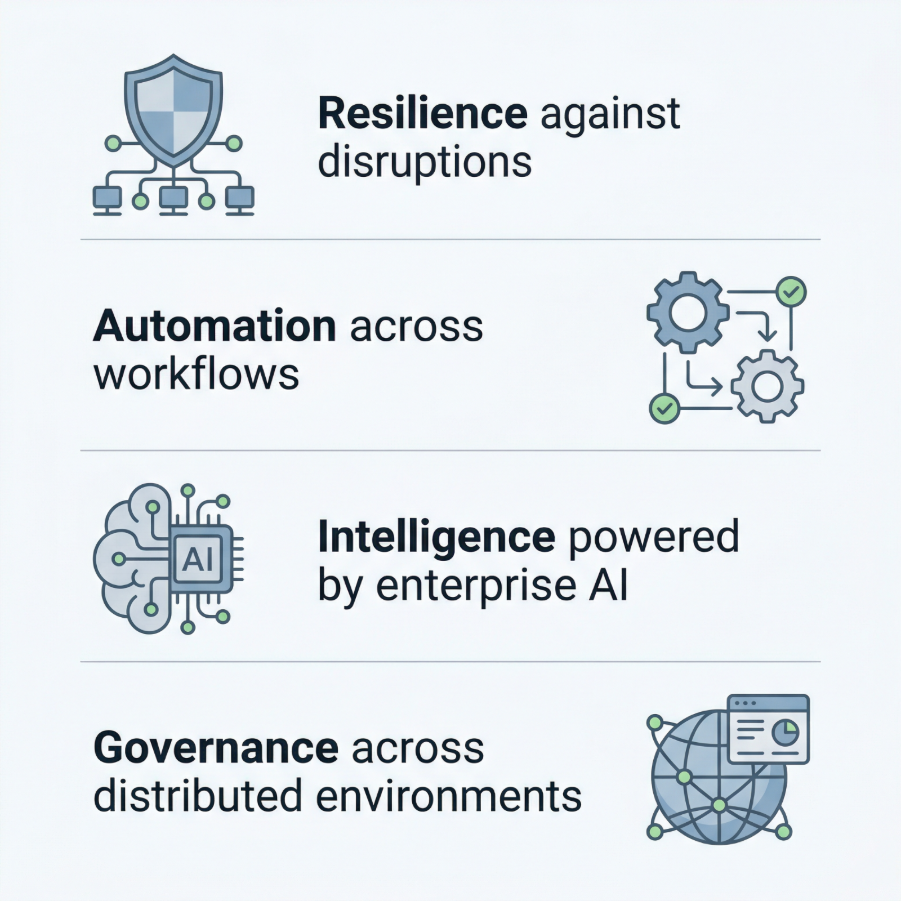
This is where IT outsourcing and a strategic IT consulting firm start to play a defining role. Instead of trying to build everything internally, enterprises are partnering with specialists to move faster, reduce complexity and execute transformation at scale.
And the urgency is real.
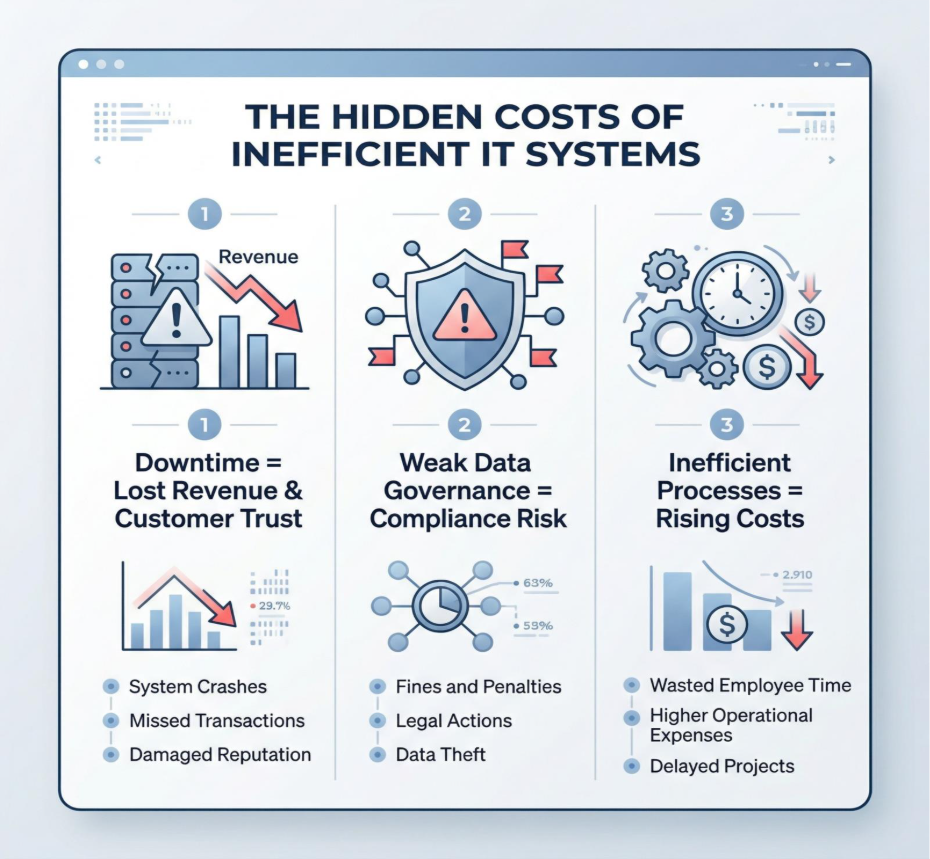
What looks like a technology gap is a business risk.
The shift to a modern IT ecosystem is not about upgrading systems. It is about ensuring the business can respond, adapt and compete in a world that is moving faster than ever.
The 7 Capabilities Defining Enterprise IT in 2026
The shift to a modern IT backbone is not driven by one breakthrough. It is built through a set of foundational capabilities that work together to create speed, intelligence and resilience.
These are not future ideas. They are already being implemented by enterprises that are moving faster, operating smarter and scaling without friction.
Here are the capabilities that are quietly redefining how enterprise IT operates.
1. AI-Driven Operations (AIOps)
This is where enterprise AI stops being a side experiment and starts running the core.
Instead of reacting to incidents, systems begin to predict and resolve them before they escalate. AIOps uses machine learning to identify anomalies, automate responses and continuously optimize performance in real time.
A financial services firm, for instance, uses AIOps to detect fraud patterns instantly, cutting response time by nearly 60 percent.
- Moving from reactive monitoring to predictive intelligence
- Replacing manual fixes with automated resolution workflows
What you gain:
Less downtime, faster decisions and a significant drop in operational overhead.
2. Intelligent Cloud Governance
Cloud gave enterprises flexibility. Multi-cloud gave them complexity.
Without governance, costs spiral, compliance weakens and performance becomes unpredictable. Intelligent cloud governance brings structure through automated policies, cost controls and performance monitoring across environments.
This is where structured cloud security and governance frameworks become critical, something Claritus addresses through its cloud security and governance solutions
An e-commerce company implemented automated governance layers and reduced cloud spend by 25 percent without impacting performance.
3. Security Built into the System, Not Added Later
Security is no longer something you layer on top. It must be embedded into how systems are designed.
Modern enterprises are shifting toward identity-first and zero trust architectures where every access point is verified continuously. According to reports, this approach can reduce breach impact by up to 50 percent.
A healthcare provider, for example, implemented zero trust to protect sensitive patient data across distributed systems.
- From perimeter-based defense to identity-centric security
- From static controls to continuous verification
What you gain:
Lower risk exposure and a much stronger compliance posture.
4. Data Intelligence That Actually Drives Decisions
Most enterprises have data. Very few are using it well.
Modern BI is not about dashboards. It’s about turning real-time data into decisions. That means combining analytics, visualization and AI to surface insights when they matter.
According to Adobe, data-driven organizations are 23 times more likely to acquire customers
A retail company used real-time BI dashboards to optimize inventory and improve forecasting, directly impacting revenue.
What works best:
- Interactive dashboards for real-time visibility
- Predictive analytics instead of historical reporting
- Focus on outcomes, not just data collection
What you gain:
Sharper decisions, higher ROI and better customer experiences.
5. Automation as the Default, Not an Upgrade
Manual processes don’t just slow things down. They create compounding inefficiencies across the business.
An automation-first architecture ensures workflows are streamlined end-to-end, not just at isolated touchpoints.
6. The Integration Layer That Connects Everything
Most enterprise inefficiencies come from one simple issue: systems don’t talk to each other.
A scalable integration layer connects applications, data sources and platforms so information flows in real time across the organization.
One enterprise unified its CRM, ERP and analytics systems to create a single, consistent customer view across teams.
What you gain:
Better collaboration, faster insights and a smoother experience for both teams and customers.
7. IT Outsourcing as a Growth Engine, not a Cost Play
The fastest-moving enterprises aren’t building everything themselves.
They’re partnering smartly.
IT outsourcing, when done right, is no longer about saving costs. It’s about accessing expertise, accelerating execution and staying ahead of constant technological shifts. A strong IT consulting firm becomes an extension of your strategy, not just your operations.
Where the shift is happening:
- From cost reduction to capability building
- From short-term support to long-term transformation
What you gain:
Faster time to market, better execution and a significantly higher return on technology investments.
The Real Challenges Enterprises Face and How to Solve Them
1. Legacy Systems Slowing Innovation
Problem: Legacy systems make even small changes slow and risky, forcing teams to prioritise maintenance over innovation.
Solution: Adopt gradual modernisation with hybrid architectures, where modern systems are layered alongside legacy ones to enable faster releases without disruption.
2. Skill Gaps in AI and Cloud
Problem: Internal teams often lack the expertise to scale AI and cloud initiatives, causing projects to stall at the pilot stage.
Solution: Leverage strategic IT outsourcing and partnerships to access specialised skills, accelerate execution and move faster from idea to impact.
3. Data Silos
Problem: Disconnected systems lead to fragmented data, delayed insights and poor decision-making.
Solution: Implement unified data platforms and integration layers to enable real-time data flow across systems and teams.
4. Security Complexity
Problem: As environments become more distributed, traditional security models fail to keep up, increasing risk and compliance challenges.
Solution: Shift to zero trust and automated security frameworks that continuously verify access and adapt to evolving threats.
Building the IT Backbone for 2026
The enterprises that win in 2026 will not be the ones with the most technology. They will be the ones with the most aligned, intelligent and resilient IT backbone.
The shift is already underway.
AI is moving into core operations. Automation is replacing manual workflows. And modern IT ecosystems are becoming the difference between businesses that move fast and those that don’t. This is where IT outsourcing, enterprise AI transformation and the role of a strong IT consulting firm become critical. Not just to support systems, but to shape how the business operates and scales.
For many enterprises, the challenge is not knowing what to build. It is executing without disruption.
That is where the right partner makes a measurable difference.
Claritus Consulting supports enterprises in building future-ready IT backbones across cloud, data, AI and governance: The gap to 2026 is not small. Closing it requires a clear, outcome-driven approach to transformation.
Explore Solutions
Ready to build your 2026 IT backbone?
Explore how Claritus Consulting can help you design, implement and scale a future-ready IT ecosystem that drives resilience, automation and growth.
Frequently Asked Questions (FAQs)
1. Why is IT outsourcing becoming essential for enterprise IT in 2026?
IT outsourcing is becoming essential because enterprises need to scale AI, cloud and automation faster than internal teams can support. It enables access to specialised expertise, reduces execution time and helps organisations build a modern IT ecosystem without slowing down core operations.
2. How does AI transform enterprise IT operations?
AI transforms enterprise IT operations by shifting them from reactive to predictive. Through enterprise AI transformation, organisations can automate incident management, optimise system performance and make real-time decisions, significantly improving efficiency and reducing downtime.
3. How do you choose the right IT consulting firm for digital transformation?
The right IT consulting firm should combine technical expertise in AI, cloud and data with a strong understanding of business outcomes. Enterprises should look for partners that can design scalable architectures, accelerate implementation and support long-term transformation, not just short-term projects.
4. What defines a modern IT ecosystem in 2026?
A modern IT ecosystem is built on integrated systems that combine enterprise AI, cloud governance, automation, data intelligence and security. These components work together to create a scalable, resilient and intelligent IT backbone that supports real-time decision-making.
5. How can Claritus Consulting support enterprise IT transformation?
Claritus Consulting helps enterprises build a modern IT ecosystem by combining expertise in AI, cloud, data and governance. Through strategic IT outsourcing and consulting, it supports organisations in designing scalable architectures, accelerating implementation and transforming legacy systems into future-ready IT backbones.
