






When Does Staff Augmentation Make More Sense Than Hiring Full-Time Employees?
Quick Answer:
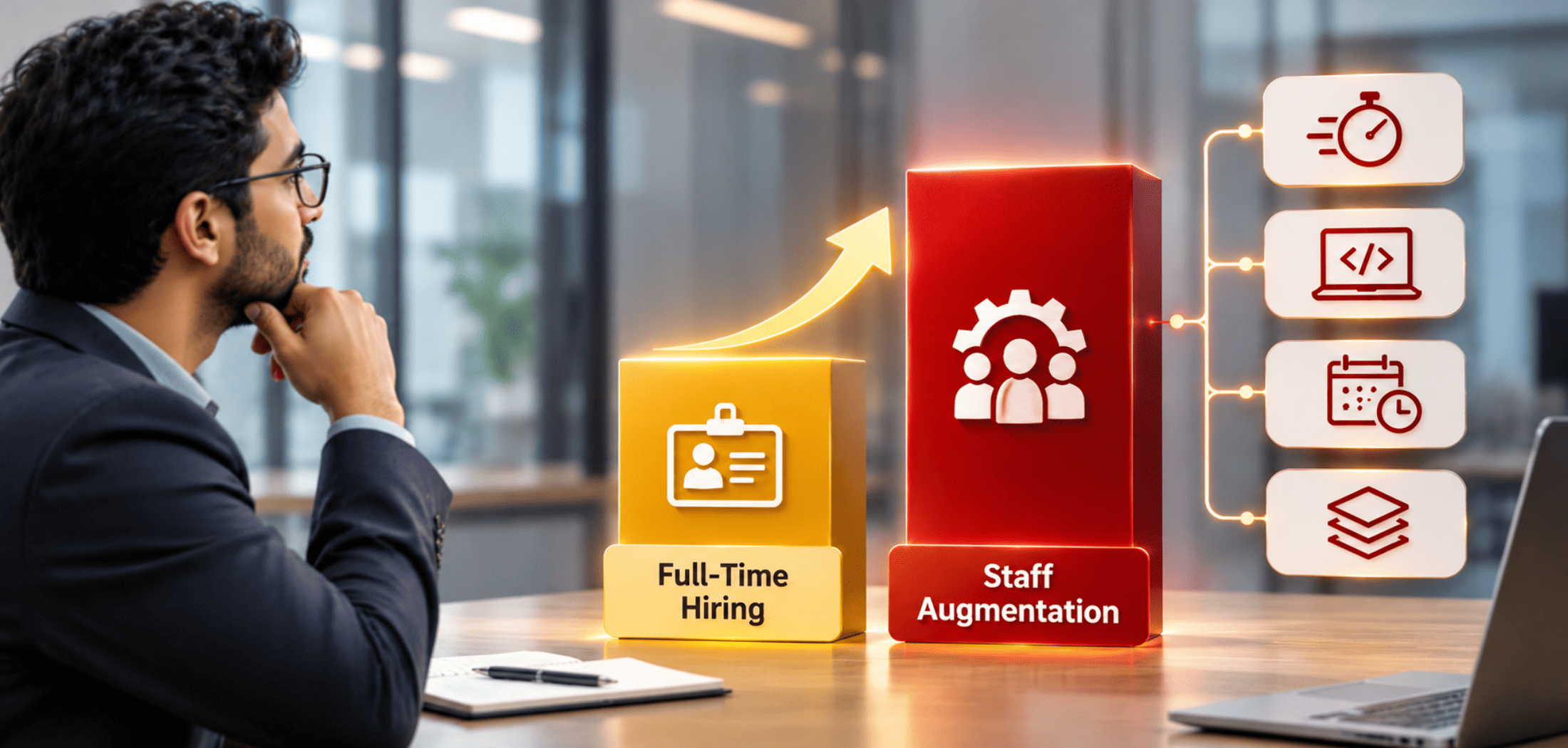
Staff Augmentation often makes more sense than full-time hiring when organizations need specialized expertise quickly, must scale teams for time-bound initiatives, or require greater workforce flexibility without long-term employment commitments. It allows businesses to access skilled professionals while maintaining control over projects, budgets, and delivery timelines.
Key Overview:
Hiring full-time employees remains an important part of long-term workforce planning. However, not every business challenge requires a permanent addition to the organization. In many situations, the speed of technology change, project-based demands, and evolving skill requirements create workforce needs that traditional recruitment processes struggle to address efficiently.
As organizations pursue digital transformation, cloud adoption, software development, analytics initiatives, and modernization programs, leaders increasingly evaluate whether permanent hiring or Staff Augmentation provides the most practical path forward. The answer is rarely determined by cost alone. It depends on business objectives, delivery timelines, talent availability, and the level of workforce flexibility required to achieve desired outcomes.
The Workforce Challenge Is Changing Faster Than Recruitment Models
A business may decide to migrate applications to the cloud, launch a customer-facing platform, strengthen cybersecurity capabilities, implement analytics solutions, or modernize legacy systems. Securing the required expertise for these initiatives can become a significant challenge when specialized technical talent remains difficult to source and retain.
Traditional hiring processes often involve multiple recruitment stages, notice periods, onboarding activities, and long-term workforce planning considerations. When immediate delivery requirements exist, these timelines may not align with business expectations.
Staff Augmentation provides an alternative approach by enabling organizations to access qualified professionals within project-driven timeframes while maintaining operational momentum.
Permanent Hiring and Staff Augmentation Serve Different Objectives
Workforce decisions are most effective when aligned with business needs rather than viewed as competing models.
Full-time hiring works particularly well when organizations require long-term institutional knowledge, ongoing operational ownership, leadership continuity, and stable workforce capacity. These roles contribute to organizational culture, business continuity, and strategic growth over extended periods.
Staff Augmentation serves a different purpose. It enables access to specialized expertise, additional delivery capacity, and technical skills that may only be required for a specific program, project phase, or transformation initiative.
The choice is not necessarily one approach over the other. Many successful organizations combine both models to create a workforce structure that balances stability and adaptability.
Specialized Expertise Is Not Always a Permanent Requirement
Technology initiatives frequently require highly specific capabilities that may not justify a permanent position.
Examples include:
- Cloud migration specialists.
- Data engineers.
- Power BI developers.
- DevOps professionals.
- AI and machine learning engineers.
- Enterprise architects.
- Cybersecurity specialists.
- Application modernization consultants.
Demand for these skills often peaks during critical project phases before returning to more predictable operational requirements.
IT Staff Augmentation helps organizations access these capabilities when they are needed while maintaining alignment between workforce investment and business demand.
Project Timelines Can Influence Workforce Strategy
Many technology projects operate against fixed deadlines.
Product launches, modernization programs, regulatory requirements, acquisitions, customer commitments, and strategic initiatives frequently have delivery expectations that cannot be postponed while recruitment efforts continue.
Staff Augmentation Services provide a mechanism for accelerating team formation without disrupting existing workforce planning strategies.
Rather than waiting months to secure permanent hires, businesses can supplement their existing teams with qualified professionals who contribute from the earliest stages of project execution.
Workforce Flexibility Creates Operational Advantages
Growth periods, budget adjustments, changing market conditions, technology shifts, and evolving customer expectations all influence workforce requirements.
Flexible workforce models allow organizations to adapt resources according to changing business demands.
This flexibility can be particularly valuable when organizations are:
- Expanding into new technology areas.
- Conducting proof-of-concept initiatives.
- Managing seasonal project fluctuations.
- Supporting digital transformation programs.
- Addressing temporary capability gaps.
- Scaling delivery teams during periods of growth.
Flexible Workforce Solutions help organizations respond to these changes without creating workforce structures that may later become difficult to optimize.
Knowledge Transfer Can Be More Effective Than Many Organizations Expect
Some leaders hesitate to adopt Staff Augmentation because they assume external resources provide limited long-term value.
In practice, experienced augmented professionals often contribute beyond immediate project delivery. They introduce specialized methodologies, technical best practices, implementation experience, and insights gained across multiple industries and technology environments.
The result is not merely additional capacity but also the transfer of practical expertise that supports future organizational growth.
Financial Decisions Extend Beyond Salary Comparisons
Workforce economics involve far more than compensation costs.
Permanent hires typically include recruitment expenses, onboarding investments, training requirements, benefits, retention programs, infrastructure support, and long-term employment obligations.
These investments are often justified when skills remain central to ongoing business operations.
However, when expertise is only required for a defined period, organizations may find greater value in aligning workforce costs directly with project outcomes.
Staff Augmentation allows businesses to create more predictable resource planning models that correspond closely with delivery requirements.
The objective is not necessarily reducing expenditure. It is ensuring workforce investments remain aligned with business priorities.
Scaling Delivery Teams Without Disrupting Operations
One of the most significant advantages of Staff Augmentation is the ability to scale efficiently while preserving operational continuity.
Internal teams often balance multiple responsibilities including customer support, maintenance activities, operational management, stakeholder engagement, and ongoing development priorities.
A Dedicated Development Team or Offshore Development Team can help absorb project workloads while allowing internal employees to continue supporting day-to-day business operations.
Building a Workforce Strategy Around Business Agility
Organizations increasingly recognize that business agility depends on accessing the right expertise at the right time and in the right capacity.
Some capabilities warrant permanent investment. Others are best addressed through Technical Resource Augmentation and project-based workforce expansion.
Understanding which approach supports a specific business objective is often more valuable than attempting to apply a single workforce strategy across every initiative.
Aligning Talent Decisions with Business Outcomes
The conversation around Staff Augmentation is ultimately about business responsiveness rather than staffing alone.
Organizations face constant pressure to innovate, modernize systems, improve customer experiences, and accelerate technology delivery. At the same time, they must remain thoughtful about workforce investments and operational efficiency.
When specialized expertise, speed, scalability, and flexibility become important considerations, Staff Augmentation can provide a practical solution that complements traditional hiring strategies and expands the options available to business leaders building high-performing teams in dynamic environments.
Accelerate Delivery with the Right Talent Strategy
Modern organizations require workforce models that can adapt as quickly as business priorities evolve. Whether supporting digital transformation, software development, cloud initiatives, or modernization programs, access to skilled professionals can significantly influence project outcomes.
Claritus helps organizations strengthen delivery capabilities through flexible Staff Augmentation solutions that provide access to the expertise needed to achieve business and technology objectives.
Expand Your Team with Confidence
Gain access to experienced technology professionals who integrate seamlessly with your existing teams and help accelerate business outcomes.
Explore Staff Augmentation Services
Frequently Asked Questions on Staff Augmentation
Is Staff Augmentation only suitable for large enterprises?
No. Businesses of all sizes use Staff Augmentation to access technical expertise, increase development capacity, and address skills gaps without making long-term hiring commitments.
How does IT Staff Augmentation differ from outsourcing?
IT Staff Augmentation adds skilled professionals directly into existing teams while the organization retains project control. Outsourcing typically transfers responsibility for project delivery to an external provider.
How quickly can augmented professionals start contributing to a project?
Timelines depend on the role, required skills, access requirements, and project complexity. When responsibilities, tools, and communication channels are prepared in advance, augmented professionals can begin contributing much sooner than through a traditional recruitment cycle.
What should businesses look for when choosing a Staff Augmentation partner?
Look for verified technical talent, flexible engagement models, transparent communication, strong screening processes, and experience across the technologies your project requires.
How can Claritus Consulting help with Staff Augmentation?
Claritus Consulting provides IT Staff Augmentation, project-based talent, dedicated teams, and domain-specific professionals, supported by a global talent network. This helps organizations add the right expertise at the right time while keeping control of their projects.
