






Why AI Success Depends on Your Vendor Relationships, Not Just Your Technology

Quick Answer
AI success depends on vendor relationships because enterprise AI increasingly operates through a connected ecosystem of models, applications, platforms, infrastructure providers, and external partners. As organizations scale AI adoption, managing these relationships becomes essential for controlling risk, maintaining governance, protecting data, managing costs, and ensuring long-term flexibility within an enterprise AI strategy.
Key Takeaway
Enterprise AI strategy is no longer only about selecting the right technology. It is also about understanding and managing the network of vendors that support AI capabilities across the organization. Businesses that treat vendor management as a core part of AI governance are better positioned to scale AI securely, maintain operational resilience, and adapt to a rapidly evolving technology landscape.
AI success depends on vendor relationships because enterprise AI relies on an interconnected network of models, applications, data platforms, infrastructure, and service providers. As adoption scales, the quality, resilience, transparency, and flexibility of those relationships shape how securely and sustainably AI can operate.
That changes what an enterprise AI strategy needs to address. The question is no longer simply What can AI do for us? It is also Who will we depend on to make it work, what data will flow through them, what will it cost, and how much control will we retain?
This interconnected ecosystem is the emerging AI vendor economy. It turns technology selection from a one-time purchasing decision into an ongoing discipline of managing performance, data, cost, risk, portability, and accountability.
Why Is Enterprise AI Strategy Becoming Vendor Strategy?
Traditional enterprise technology stacks were relatively easy to map: organisations knew which applications they had purchased, which vendors supported them, and where procurement, IT, and security responsibilities sat.
AI makes that picture considerably messier.
A single business workflow might involve:
- A foundation model
- An AI application
- An API provider
- Enterprise data platforms
- Cloud infrastructure
- Third-party applications
- AI agents
- Automation tools
- Monitoring and security platforms
And many of these dependencies can change independently.
A vendor can change its model. Pricing can change. Usage limits can change. Features can be bundled into another product. An API can be deprecated. A new model can outperform the one your application was originally designed around.
The technical decision therefore becomes a commercial decision. This is why enterprise AI strategy cannot stop at use-case identification.
It needs to consider:
- Who provides the capability?
- What does the organization depend on?
- How portable is that dependency?
- What happens if the vendor changes its product, pricing, security terms, or availability?
Vendor evaluation is therefore not a procurement step that follows the AI strategy; it is part of the AI strategy. Without that integration, organisations can quickly lose sight of how AI is being used and where their dependencies sit.
What Is the Biggest AI Vendor Risk?
As that vendor network expands, one of the first risks is losing visibility. Model accuracy still matters, whether a system hallucinates, produces biased answers, or makes the wrong recommendation. However, enterprises increasingly face a broader problem: understanding how and where AI is being used.
An employee might start with an approved enterprise AI assistant. A developer might connect an external API. A business team might subscribe to an AI-powered SaaS platform. Another department might deploy an AI agent to automate a workflow.
None of these decisions necessarily look significant individually. Together, they can create an AI environment that nobody has a complete view of. This is where shadow AI becomes particularly important. The problem isn’t necessarily that employees are doing something reckless. In many cases, they are simply trying to solve business problems faster than the formal technology process allows.
The enterprise challenge is to make innovation possible without losing control of data, access, security, cost, or accountability. Meeting that challenge requires procurement and governance to operate as a continuous, connected discipline.
How Should AI Procurement and Governance Work Together?
An organisation may evaluate a platform, complete security and procurement reviews, and launch it successfully, only to discover months later that features, vendors, use cases, and data flows have changed.
As AI usage expands after deployment, governance must become continuous rather than remain a one-time approval. Organisations need a lightweight way to reassess changing features, vendors, data flows, and use cases without forcing every experiment through the same process.
The answer isn’t to create a giant approval process for every AI experiment. That would simply encourage teams to work around it.
Instead, enterprises need proportionate governance.
Governance should match the potential impact of the use case. An internal summarization tool requires lighter controls than an autonomous system that can modify financial records, access sensitive customer information, or operate within a regulated workflow.
For organisations operating in India, this governance model must also account for the Digital Personal Data Protection Act, 2023 and the DPDP Rules, 2025, whose provisions follow a phased commencement. When an AI provider processes personal data on an enterprise’s behalf, the enterprise still needs clarity on what data is collected, why it is processed, where it flows, how long it is retained, which safeguards apply, and how the provider supports data-principal rights and breach response. DPDP readiness therefore reinforces the central vendor-management question: whether an AI relationship is transparent, controllable, and sustainable.
The governance conversation should therefore include questions such as:
- What data can the AI access, where is it processed, and is customer or proprietary data retained?
- Can the model, provider, pricing, or service terms change without notice?
- How resilient and portable is the workload if the service becomes unavailable or the organisation needs to switch providers?
- Who owns the AI system after deployment, and how are its performance and outputs monitored?
- Where is human review or approval required?
These are not legal questions alone. They sit at the intersection of technology, security, procurement, architecture, finance, compliance, and business operations. The next challenge is to answer them without making responsible adoption unworkably slow.
How Can Enterprises Govern AI Without Slowing Adoption?
That concern is valid because AI is moving quickly. If enterprises spend months evaluating every model, platform, contract, dependency, and governance scenario, they risk recreating the slow, bureaucratic adoption they are trying to avoid.
Proportionate governance should support experimentation while strengthening oversight as a capability moves towards production, autonomy, or long-term operational dependence. Clear thresholds should trigger stronger requirements for ownership, monitoring, security, resilience, and vendor review without creating unnecessary bureaucracy.
The answer, therefore, isn’t more bureaucracy. It is better decision-making.
Enterprises need clear thresholds for when an experiment becomes a production capability and when an advisory tool becomes an autonomous system. Those transitions should trigger stronger requirements for ownership, monitoring, security, resilience, and vendor review.
The goal is to make responsible adoption easier, not impossible. Achieving that balance requires organisations to treat AI governance as part of the wider digital-transformation agenda.
What Does AI Vendor Management Mean for Digital Transformation?
These decisions extend beyond individual AI projects. AI increasingly influences how organisations modernise applications, manage data, operate cloud environments, redesign workflows, and deliver digital experiences. As a result, it should be embedded within broader transformation efforts instead of being managed as a standalone technology program.
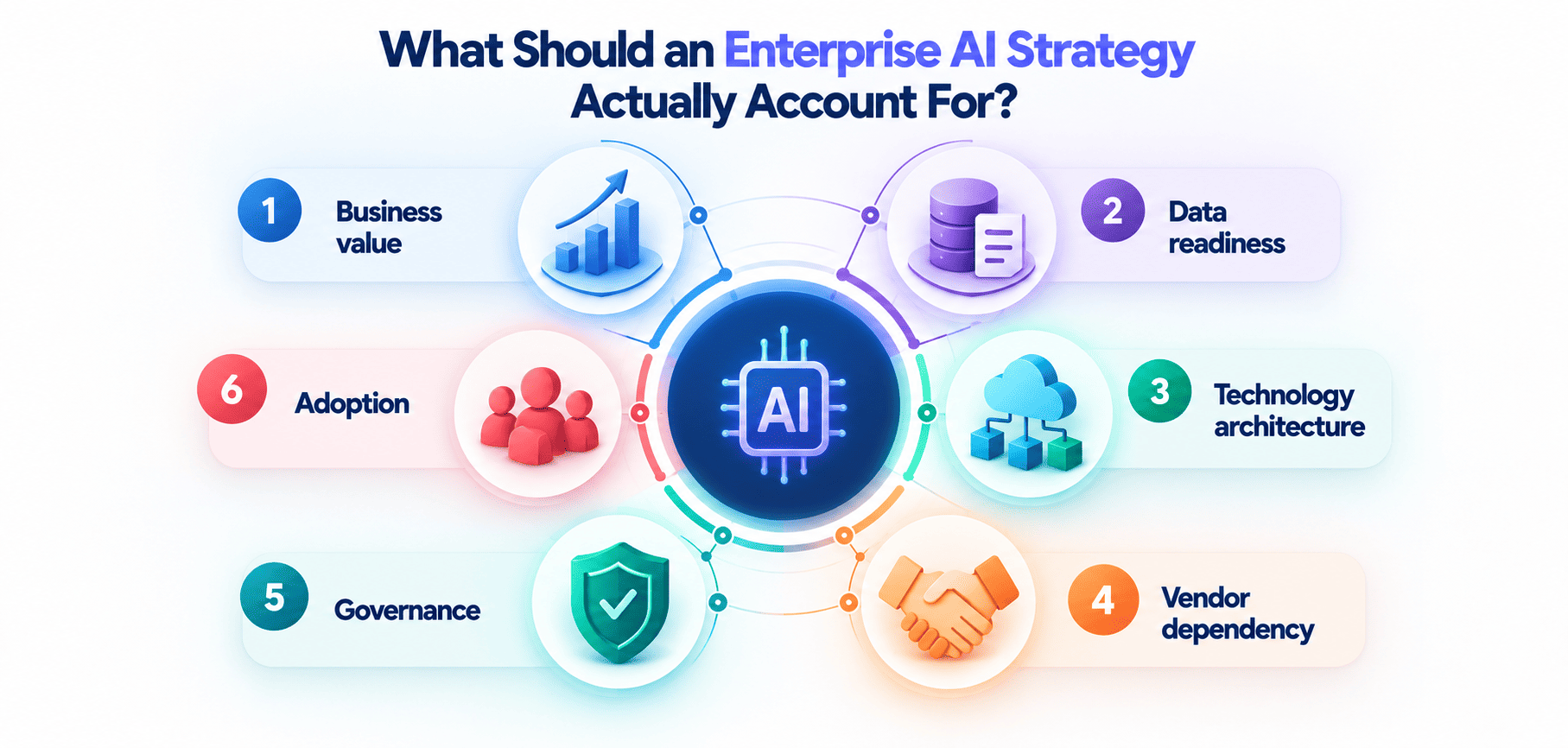
That requires an integrated approach connecting technology choices with business strategy, architecture, security, governance, cost, and operational readiness. It is the same principle that underpins Claritus Consulting: emerging technology should be managed as part of the wider enterprise environment, not as an isolated investment.
The distinction is important: implementing an AI tool is a project, while building an enterprise that can continuously adopt, govern, evaluate, replace, and scale AI is an operating capability. That broader capability provides the foundation for sustainable transformation and helps define where external expertise can add value.
How Claritus Can Help
Claritus helps organisations build that operating capability through a practical roadmap that aligns AI use cases with architecture, data readiness, security, governance, vendor evaluation, cost, and long-term transformation priorities.
The AI vendor economy is already taking shape. Organisations that succeed will understand which relationships are strategic, which risks require active oversight, and where portability or alternative providers are essential. Their advantage will come not from deploying the greatest number of AI tools, but from building a vendor strategy that can evolve with the market.
Don’t Just Adopt AI. Build an AI Strategy That Can Evolve.
Explore Claritus Generative AI Solutions
Frequently Asked Questions About AI Vendor Management
What is AI vendor management?
AI vendor management is the ongoing evaluation and oversight of the providers, platforms, models, infrastructure, data practices, costs, and dependencies that support enterprise AI.
Why do AI vendor relationships matter?
They affect data protection, service resilience, model performance, pricing, portability, regulatory compliance, and the organisation’s ability to adapt when technology or commercial terms change.
How can enterprises reduce AI vendor risk?
Enterprises can reduce risk by mapping dependencies, setting proportionate controls, monitoring vendor and model changes, defining ownership, testing resilience, and maintaining realistic portability or alternative-provider options.
How does the DPDP Act relate to AI vendors?
For organisations operating in India, AI vendor oversight should establish what personal data is processed, why and where it is processed, how long it is retained, which safeguards apply, and how data-principal rights and breach response are supported.
